

2 Thank you all for coming – and thank you to Stevie Marquez-Hall, and all of the organizers of Tallahassee Pridefest for giving me the chance to speak to you here today.
3 This talk is a preview of the research for my third book project – on the LGBTQ history of the American Revolution – which I hope to continue to refine and present over the next two years as a part of the celebrations of the 250th Anniversary of the American Revolution. I’m very happy to be able to share this first in our hometown of Tallahassee.
4 Now – some might argue that an LGBTQ history celebrating the American Revolution is problematic – given the fact that the LGBTQ community is committed to justice for all its members – in relation to race and class – as well as gender and sexuality – and that celebrating the actions of wealthy white slaveholding men occupying native land must contradict that commitment to economic and social justice
5 But this talk will argue that queer and trans individuals and our allies not only can embrace the legacy of the American Revolution – but that they must, because the American Revolution is the very foundation of queer and trans inclusion, as well as the foundation for so many of the other movements for social justice that have shaped the modern world. – Not only were the themes of gender and sexuality implicit in the ideals of the American Revolution – but, as I’ll show here today, this was acknowledged by the participants – elites and commoners alike – and it was a part of the popular debate –

6 Once we understand this, we can claim and better use the revolutionary tools central to the founding of the United States of America – to address the injustices of the contemporary world – around race, and class, and gender, and sexuality – claiming this powerful legacy that just as rightfully belongs to queer and trans individuals and our allies as to any other Americans.

7 Once we understand better what it was – we can see ourselves more easily – and naturally – as a part of the revolution.
8 So how do we do this? Where do we begin? We have to understand the world from which the American Revolution sprung – and to do that, we have to start with slavery – and how slavery was central to how and why the Americas were colonized – and we also have to understand how the unique characteristics of New World slavery were central to the remaking the world.
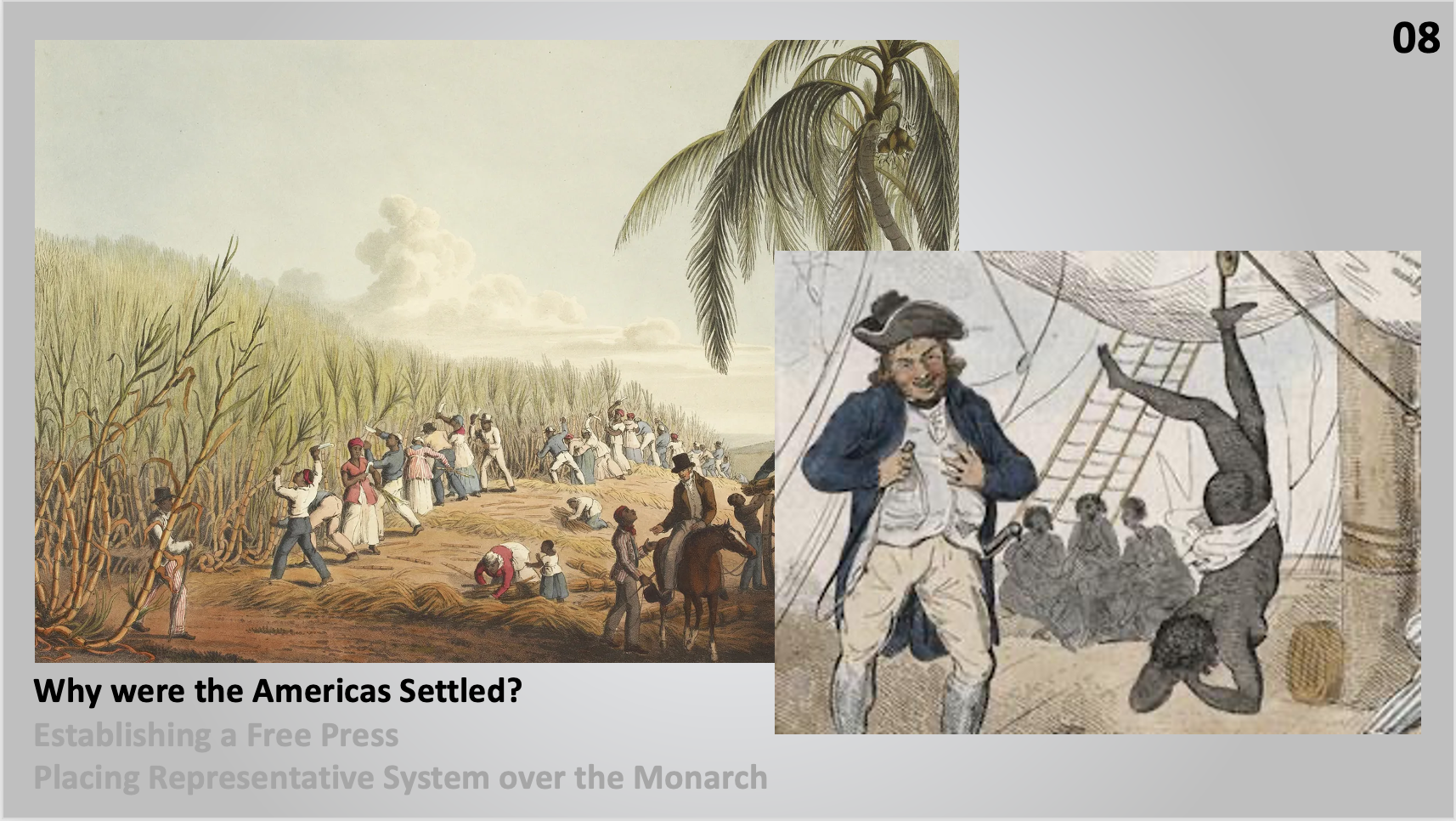
9 Systems of enslavement had existed from the earliest times of human history – but in the New World, that system became tied to a form of ever-expanding capitalist production – generating enormous profits – and where it was common practice within the sugar-producing colonies to work an enslaved individual to death, in the space of about ten years, on average, and then import their replacement – rather than allowing enslaved individuals the resources to raise children and have families of their own – The profits helped to build empires – and fueled regularly recurring wars between European states throughout the seventeenth and eighteenth centuries. It was uniquely profitable, and uniquely abhorrent in its disregard for human life.
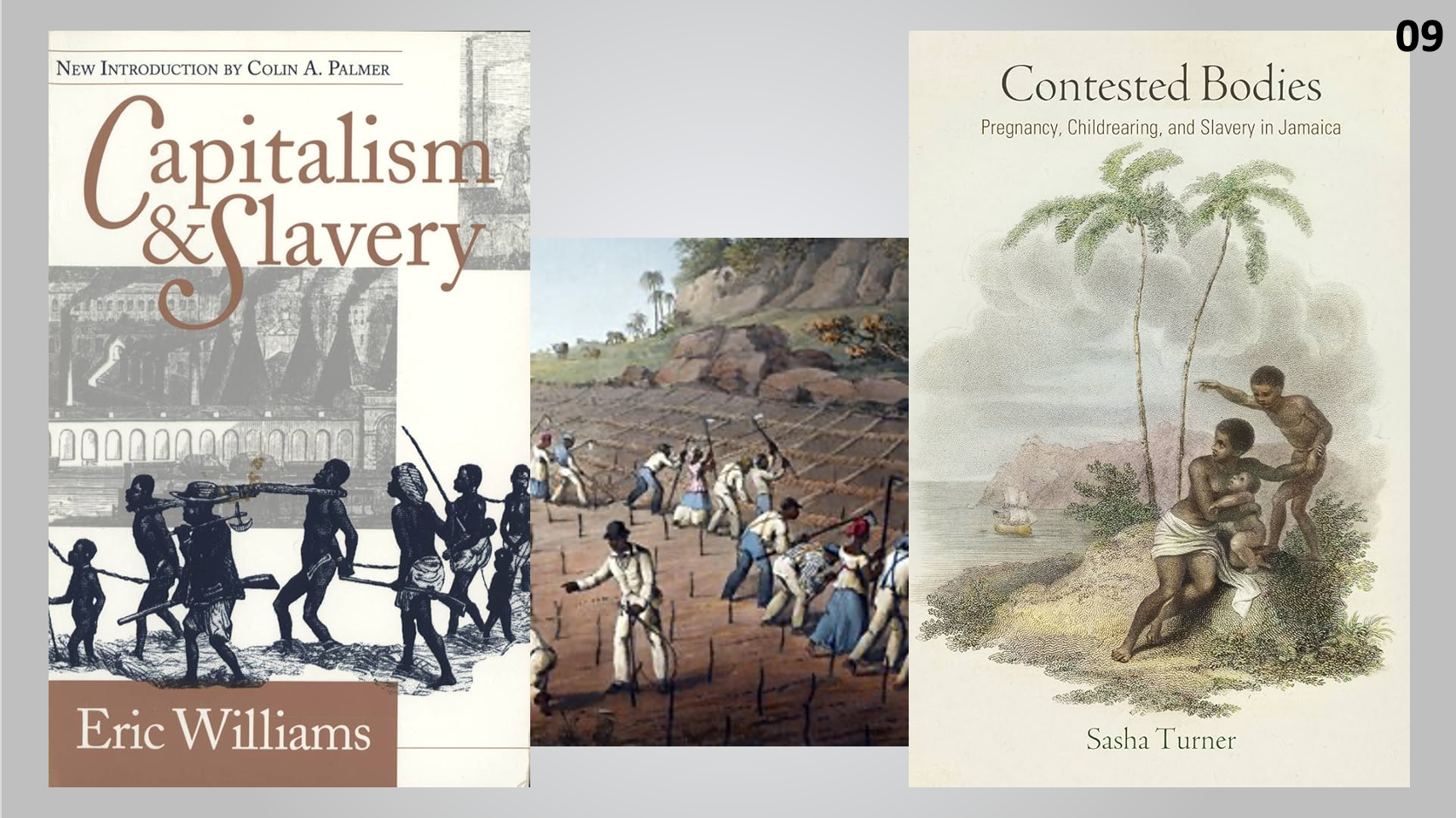
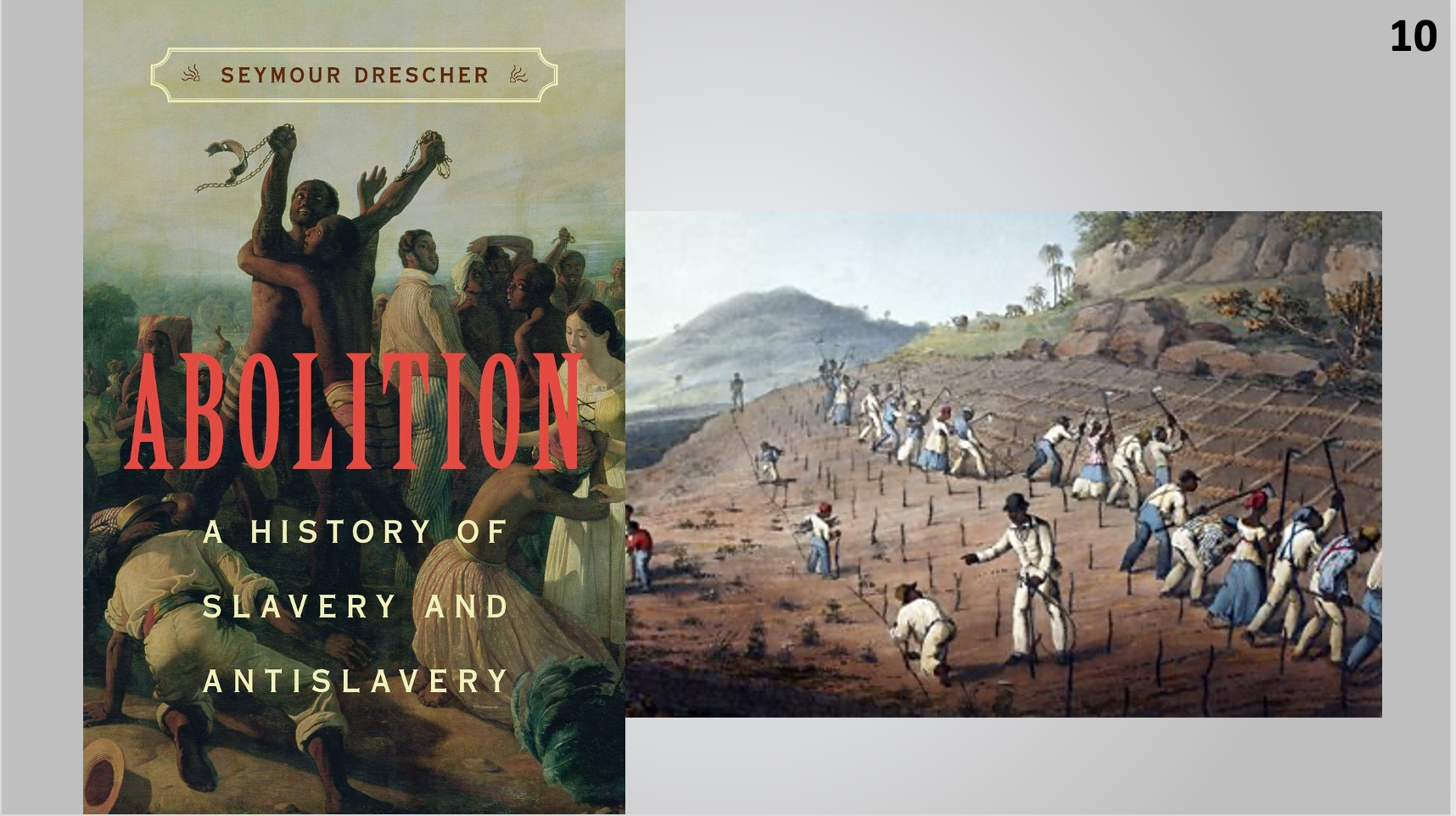
10 In an attempt to better understand how such systems of inhuman brutality were finally undone, Seymour Drescher – one of the best scholars to ever study the system of Atlantic slavery – near the end of his career analyzed every abolition of slavery that occurred without all-out warfare – and what he found was that there were two critical elements in each case – a functioning public sphere – where ideas could be debated – and a political system that responded to some degree to popular pressure
11 Neither of these were created for noble or altruistic reasons – often quite the contrary – The free press in Britain dated from the 1690s – and it was largely allowed by the state to fund the generation of warfare that secured Britain’s Glorious Revolution – In that revolution, a cross-section of the British elite had decided to keep the rightful heir to the British crown away his throne – because of his Catholic beliefs and autocratic policies – While the French, because of exactly those same beliefs and policies – were determined to place that person – James II – back on the English throne.
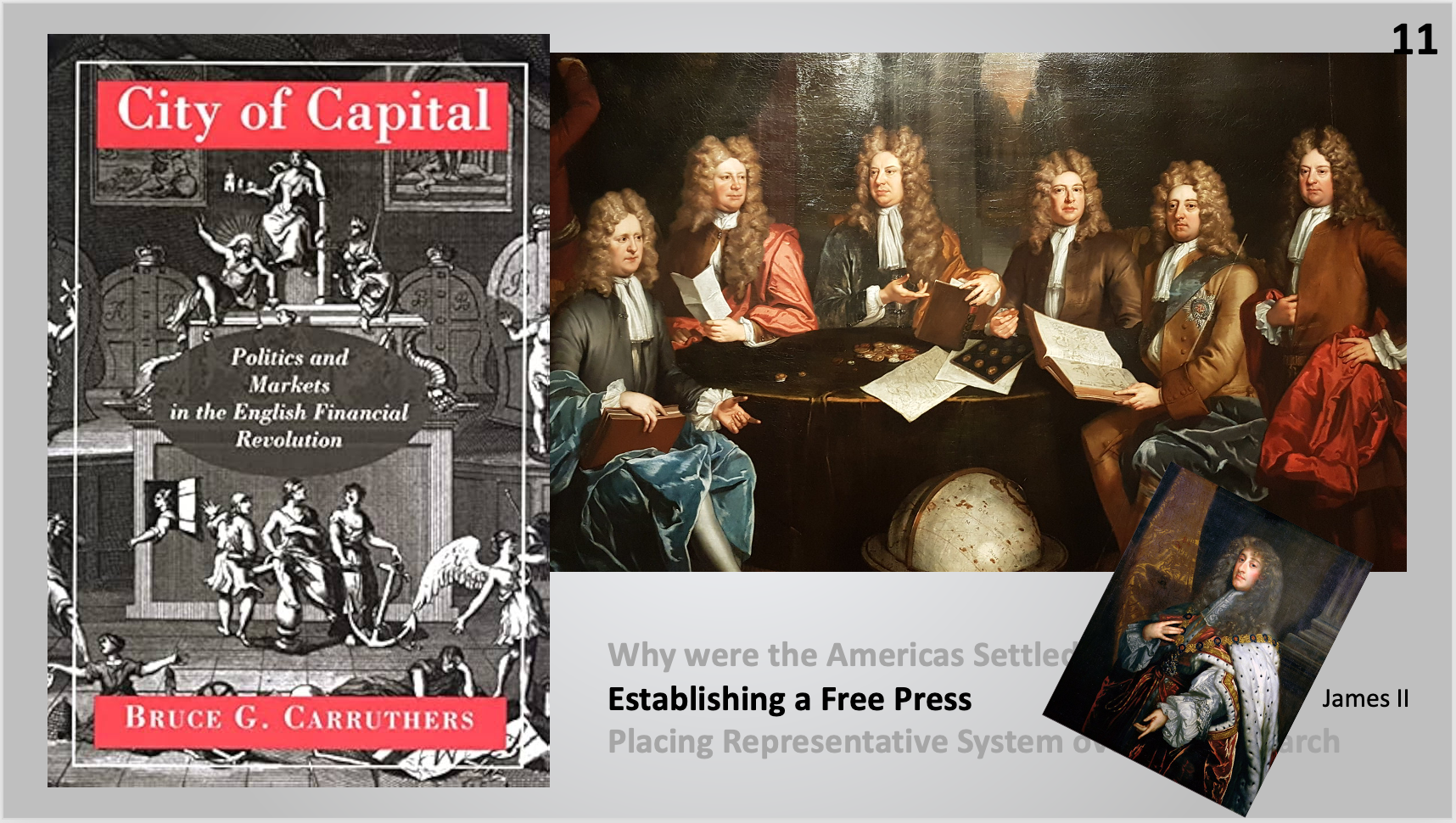
12 Fighting a foe three times their size – the British state fostered as much trade as possible – to be able to tax it – to fund decades of war. The first mass – sustained – and continuous – free press in the world was allowed because it supported the ever-expanding commercial society that enabled the British to outspend the French – The free press would have never been allowed if it was not needed for this massive and wildly profitable commercial expansion –
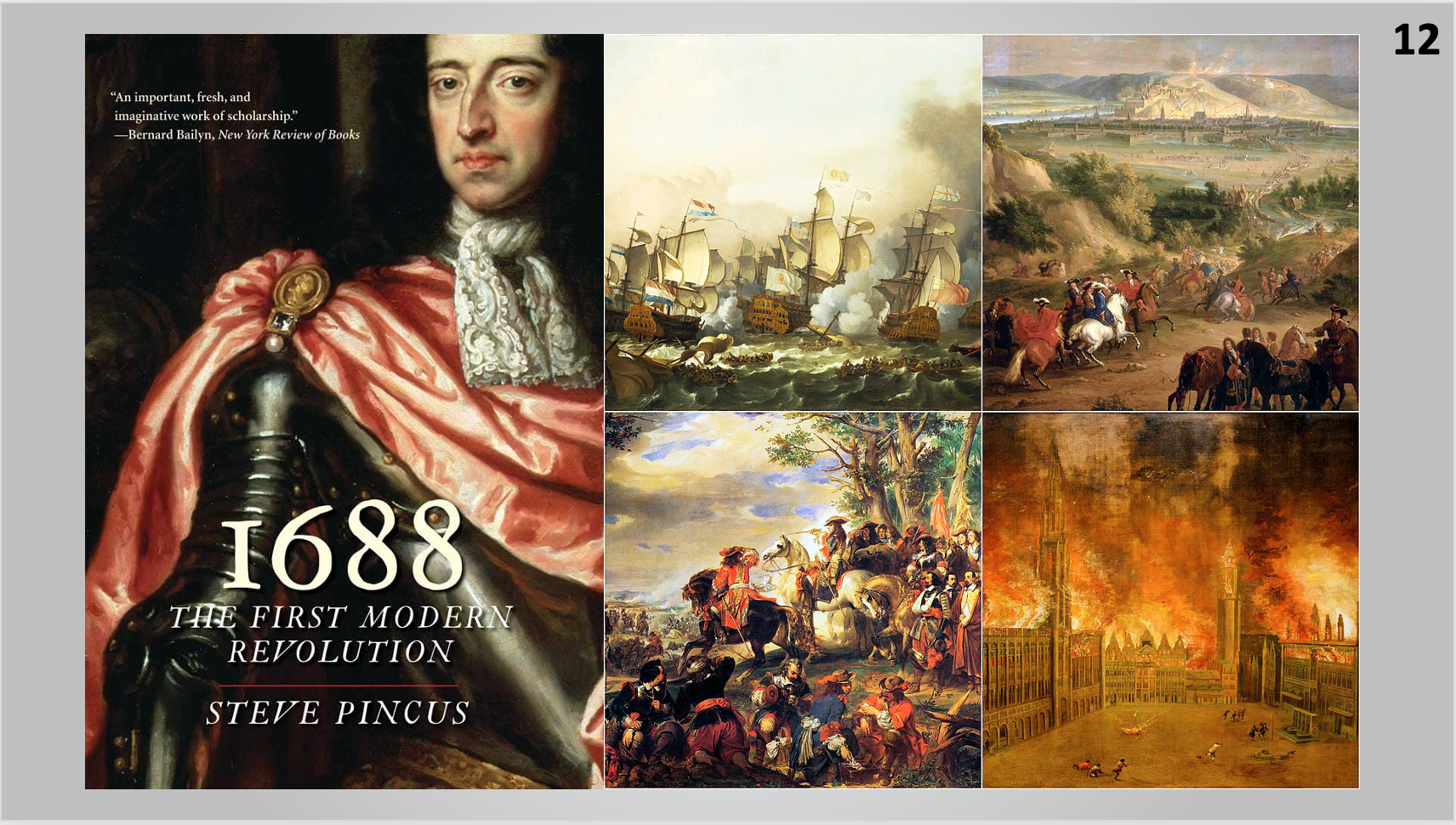
13 If the origins of a free press were less than glorious – so too were the origins of establishing the primacy of representative governing systems over the long-established principle that some ruled by hereditary right – or even divine right, given by God.

14 At first, the Whig Oligarchy that brought about the Glorious Revolution only usurped a little – in 1688 – placing the daughter of the rightful king, and her husband – on the English throne – because she agreed with them that England should remain Protestant
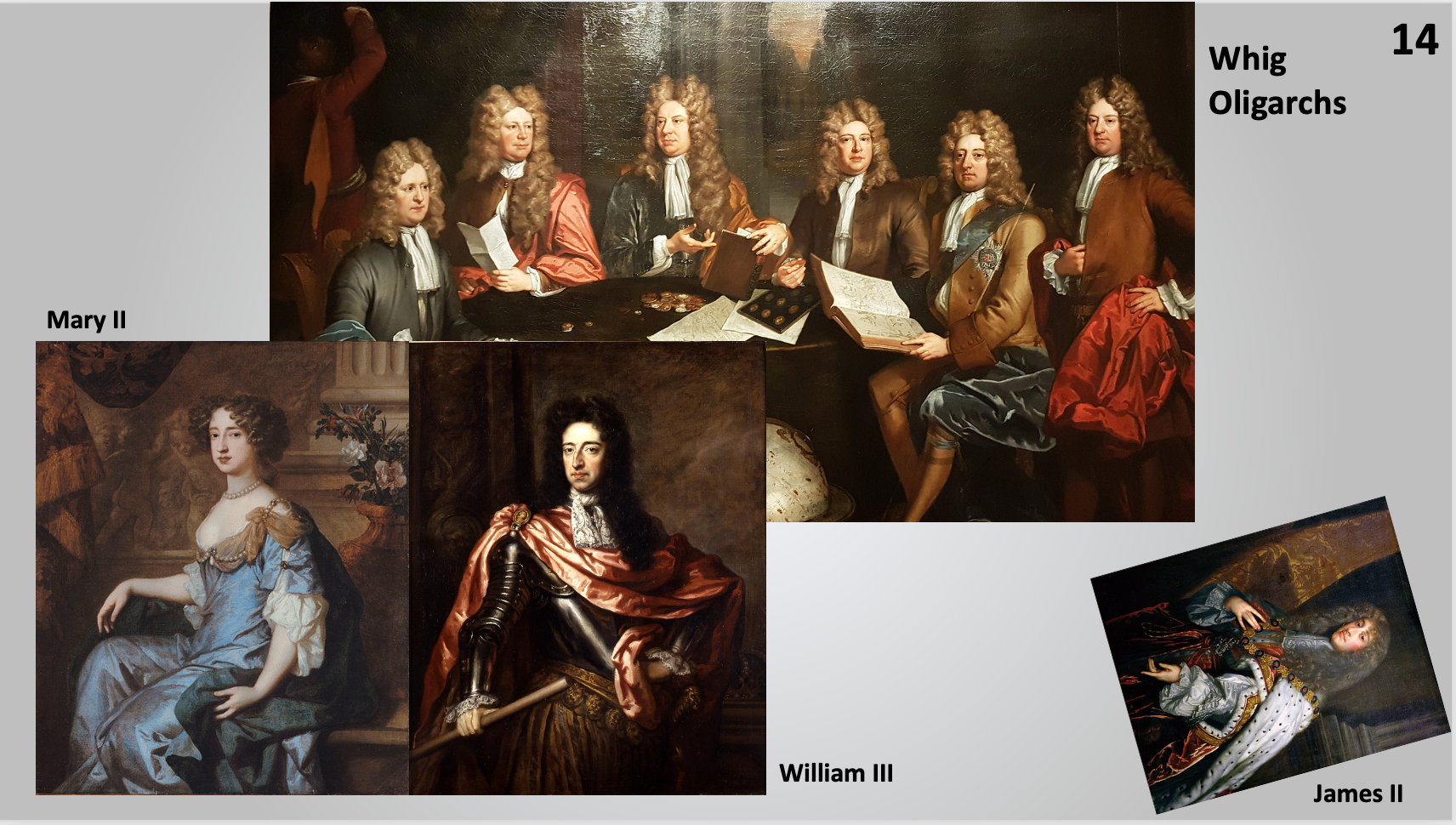
15 But then when she died, and her husband died, and her sister Anne died – they Usurped a lot – And by-passed 30 other Catholics who had a better hereditary claim to the English throne – to place a Protestant German on the throne – who never bothered to learn English – who spent much of his time in his German homeland – and when he died there almost thirteen years into his reign as the British monarch, no one in Britain bothered to ask for his body back.
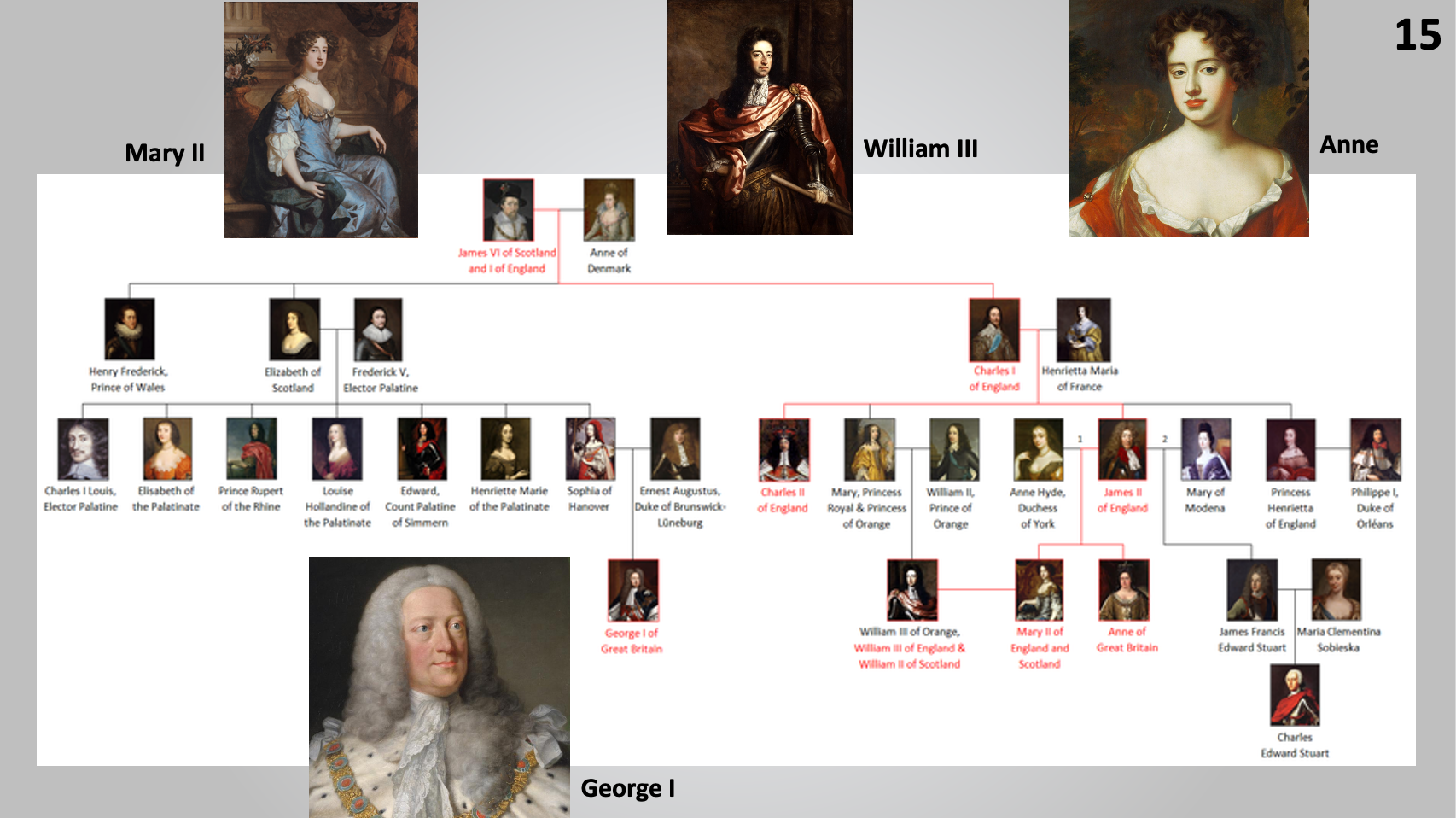
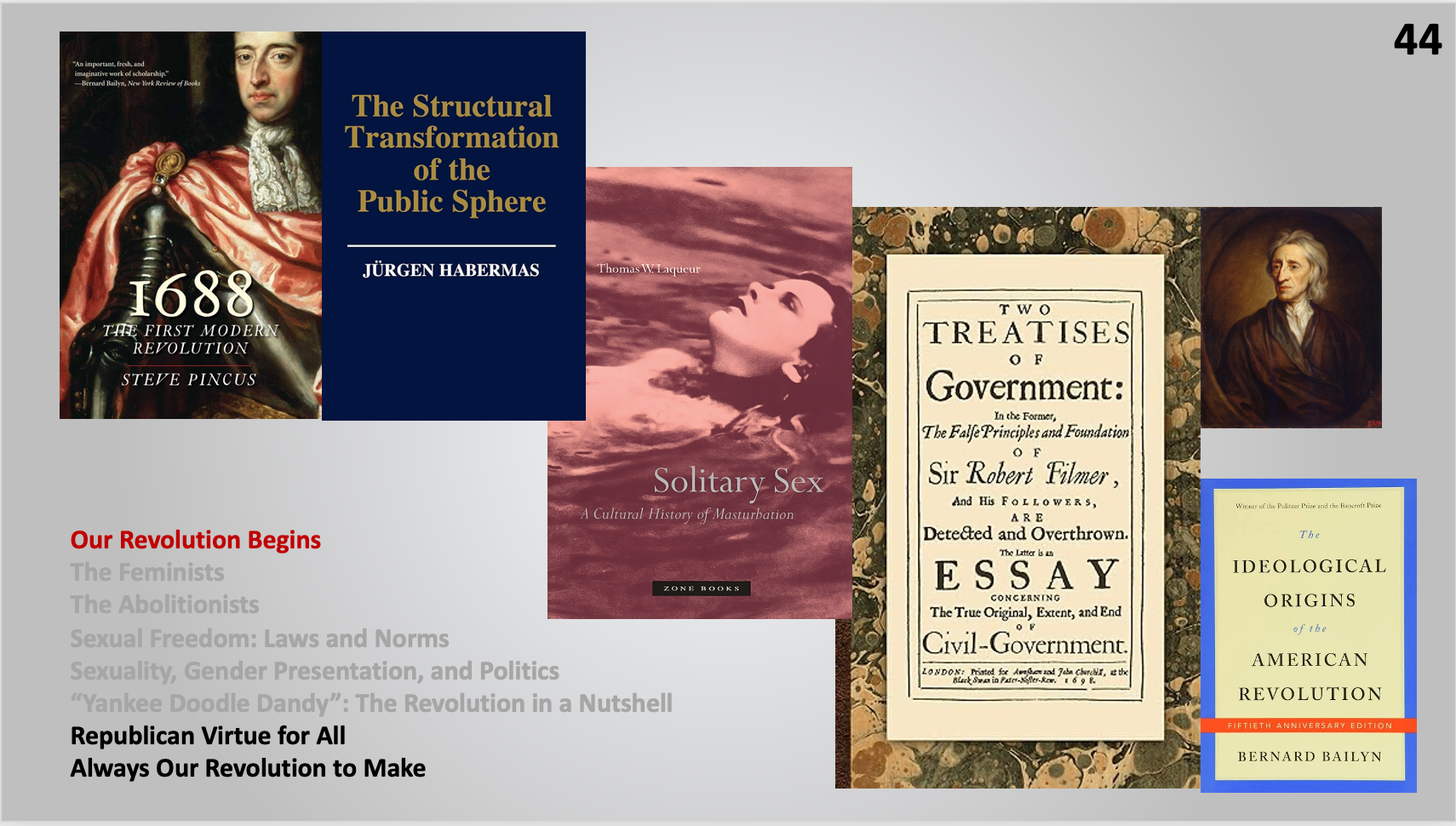
16 The Whig Oligarchs who did this brought in some new ideas – after the fact – to justify what they had done – Men like John Locke (today we call him a philosopher, but he was also the client of one of the powerful Whig Oligarchs making all this happen) – Lock constructed a reasoned argument about why – even though the Whig Oligarchs had broken their oath to the rightful king – everyone else in Britain should still obey them – building on the ideas of Thomas Hobbes, Locke made an argument that bypassed the king – and argued that sovereignty was resident in the people – that they entered into a contract with one another, pooling sovereignty into the hands of the state, in a limited number of areas, for their mutual benefit. The previous idea that a monarch ruled because of a mandate from God – was replaced by the idea that the state was a voluntary association of sovereign individuals – who had the right to set the terms of what the state could do, and what it could not.
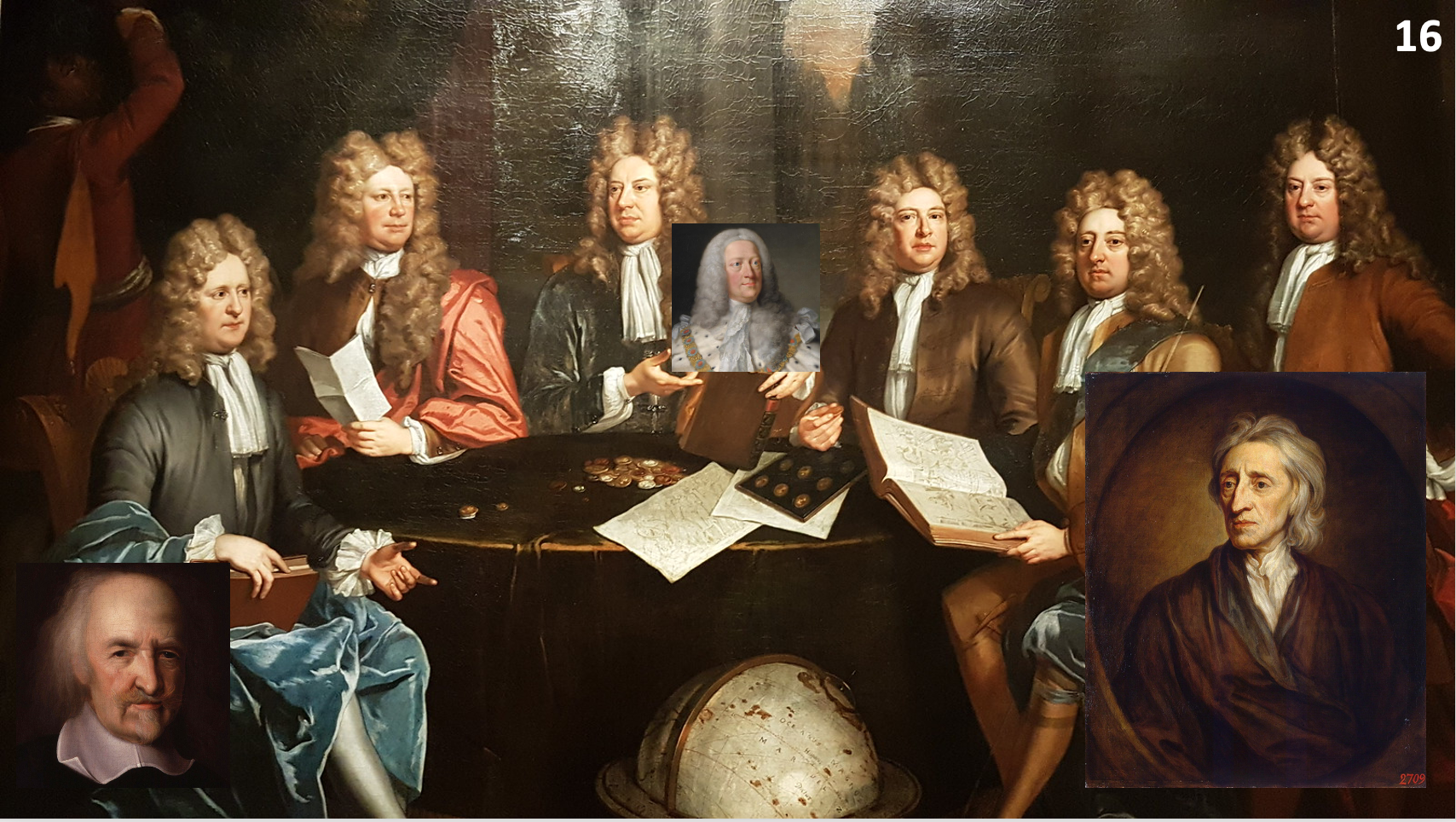
17 It was a wonderful set of ideas – but largely only window dressing for the Whig Oligarchs in parliament who controlled the system for their own purposes. A handful of powerful families ran things, and the English people were taxed more thoroughly and more harshly than any other population in Europe for the rest of the eighteenth century – to fund decade after decade of warfare with France – to build Britain’s wealth and commercial dominance –
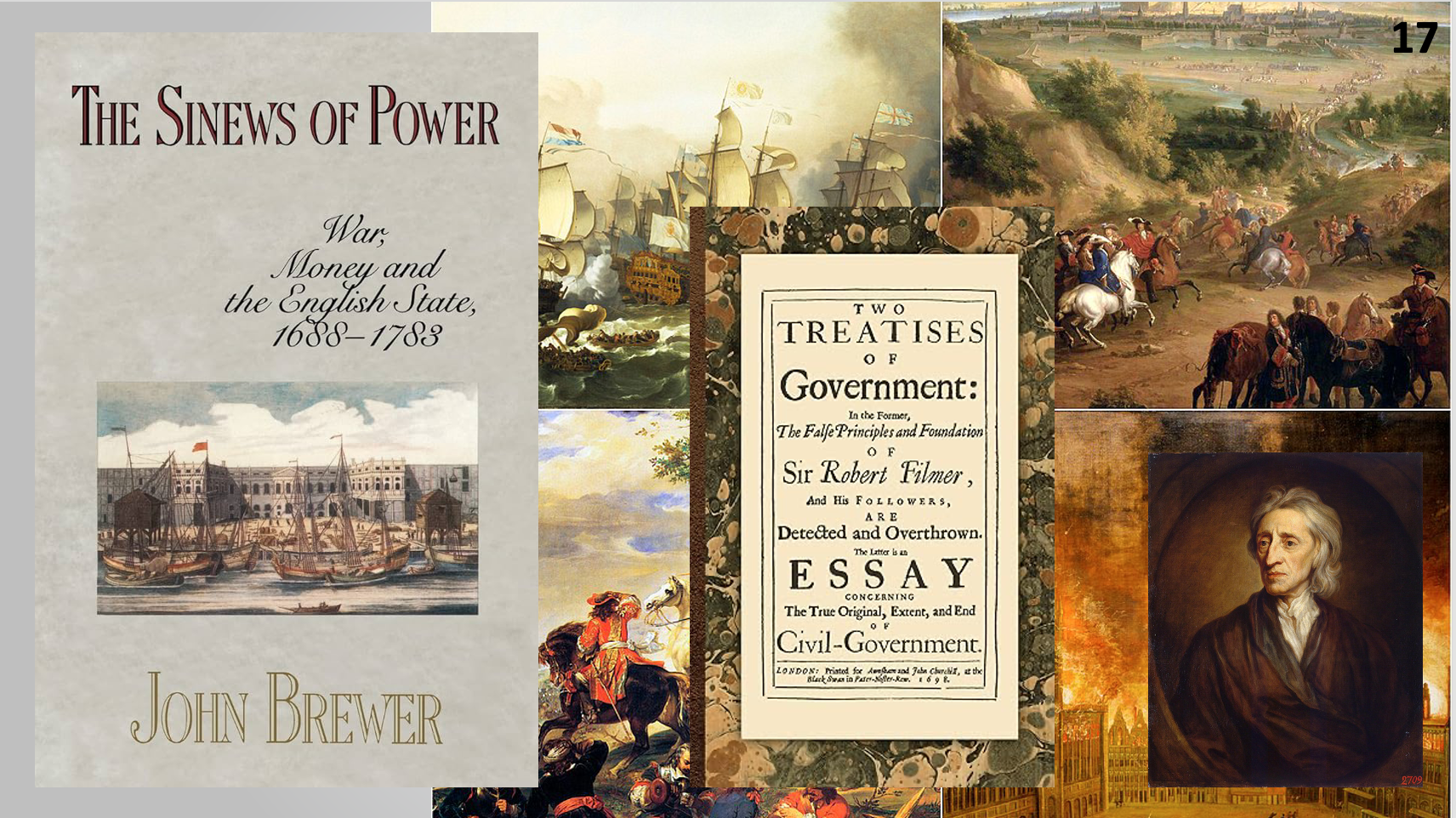
18 And yet… also, those self-centered early eighteenth-century Whig Oligarchs in Britain had to at least pay lip service to the ideas of men like Locke on what the nature of government should be – to justify their own usurpation of royal authority – and they had to allow the free circulation of ideas – because information had to flow to keep commerce going.
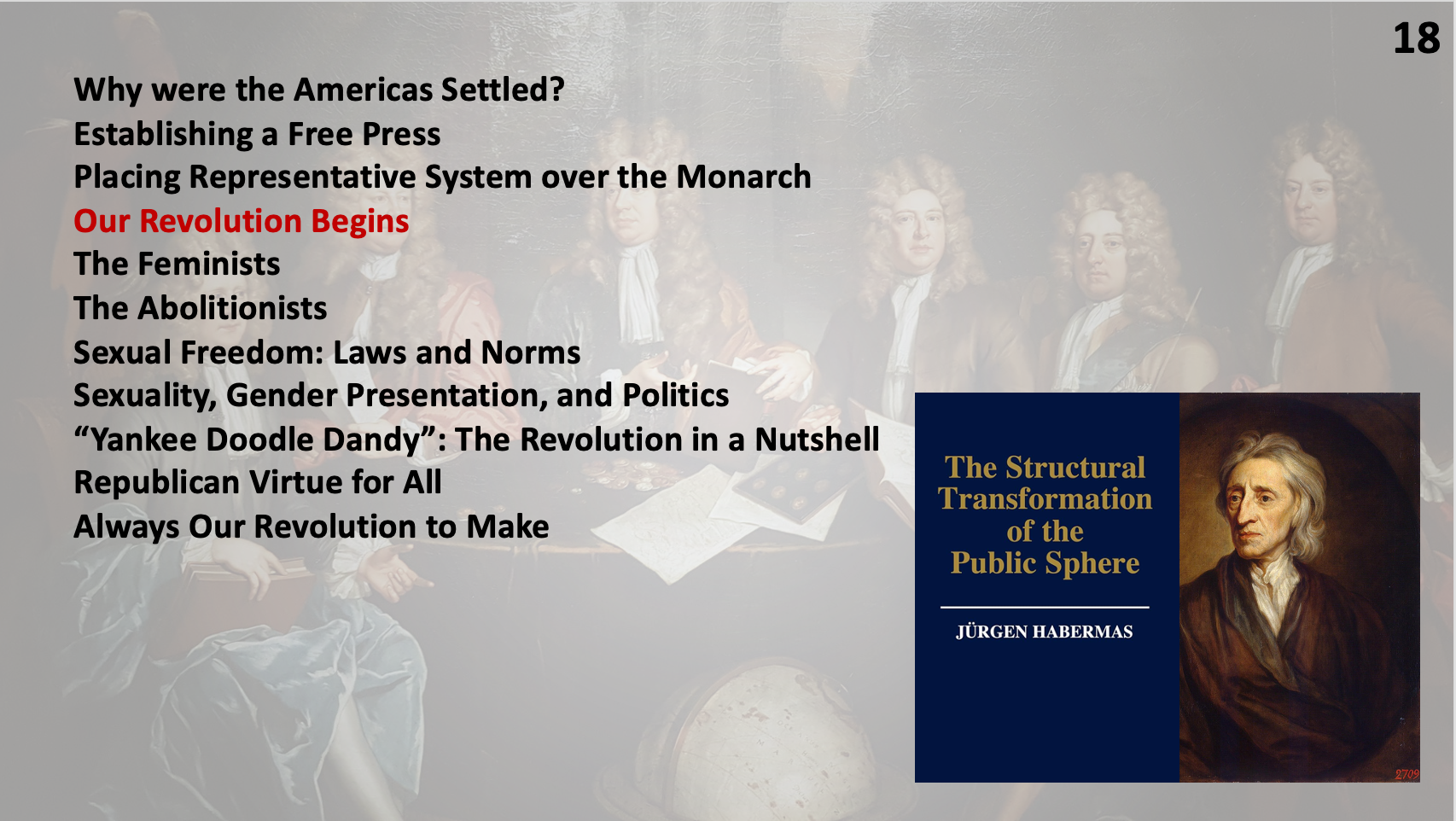
19 And in these spaces – in the early eighteenth century – our revolution began to take hold. It began with the feminists – The first coherent group to take advantage of the free circulation of ideas – and underlying logic of Locke’s Enlightenment political theory – to argue that by the ideas that justify the government after the Glorious Revolution – women, also – should be included on equal terms – as full citizens.

20 Many of the first women to do this had to use pseudonyms – as a woman presuming to speak in public would often be viciously attacked for doing so – but these women fought – often against enormous obstacles – to get their ideas into the public sphere – to argue throughout the eighteenth century against the laws that had long limited women’s rights and freedoms –

21 Also – right from the start of the free circulation of ideas – were those who used the public sphere to speak out against the inhumanity of the Atlantic slave trade – Lone voices at first – separate from political power – but with a moral force drawn from religion – of everyone being a soul of worth – they powerfully argued against the inhumanity of Atlantic slavery –

22 In 1772 in Britain – Common people dealt a serious blow to plantation elites – James Somerset, an enslaved man brought to England – self-emancipated – and was helped by his Methodist congregation – who publicized his plight – raised money for his legal defense – and they won their court case – with the Lord Chief Justice of Britain declaring that no one could be enslaved in Britain – and that Caribbean slavery was uniquely onerous to human dignity – it was an early great victory against slavery – won in the public sphere – by average individuals.
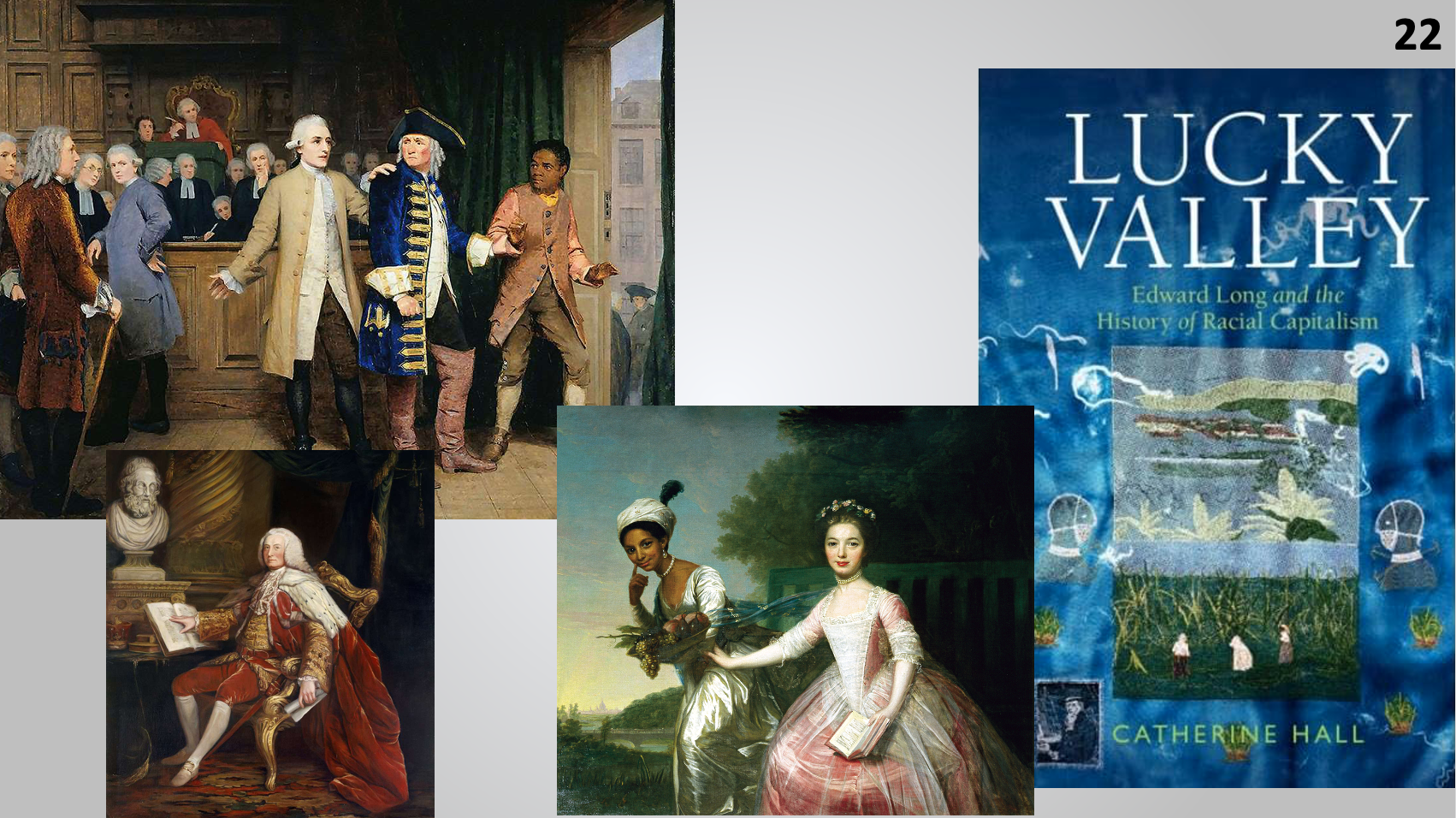
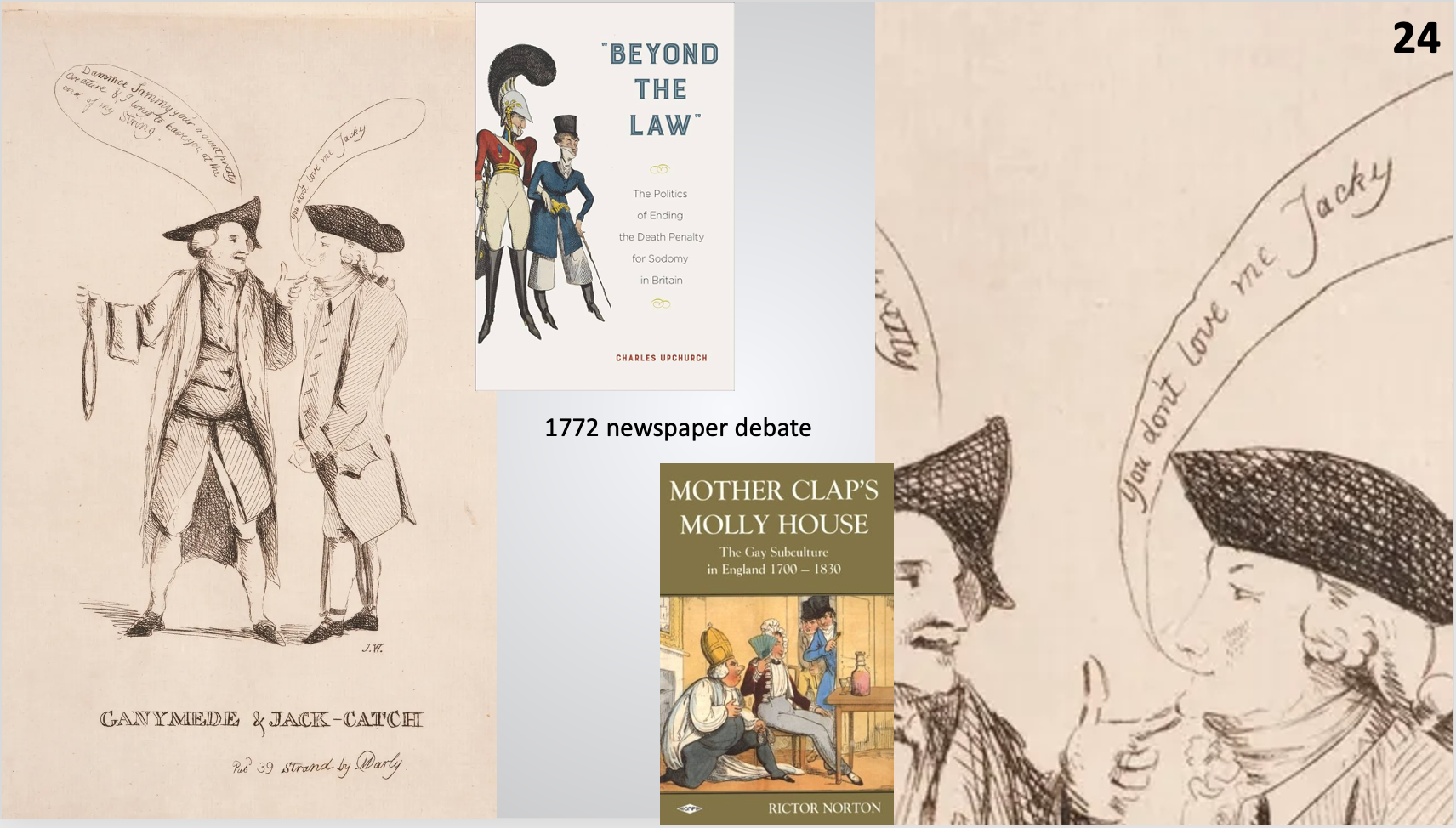
23 The laws against sex between men were also regularly debated in the eighteenth century – Enlightenment ideals led to the conclusion that private consensual acts between adults – including all forms of sex between men – should not be punished by the law –
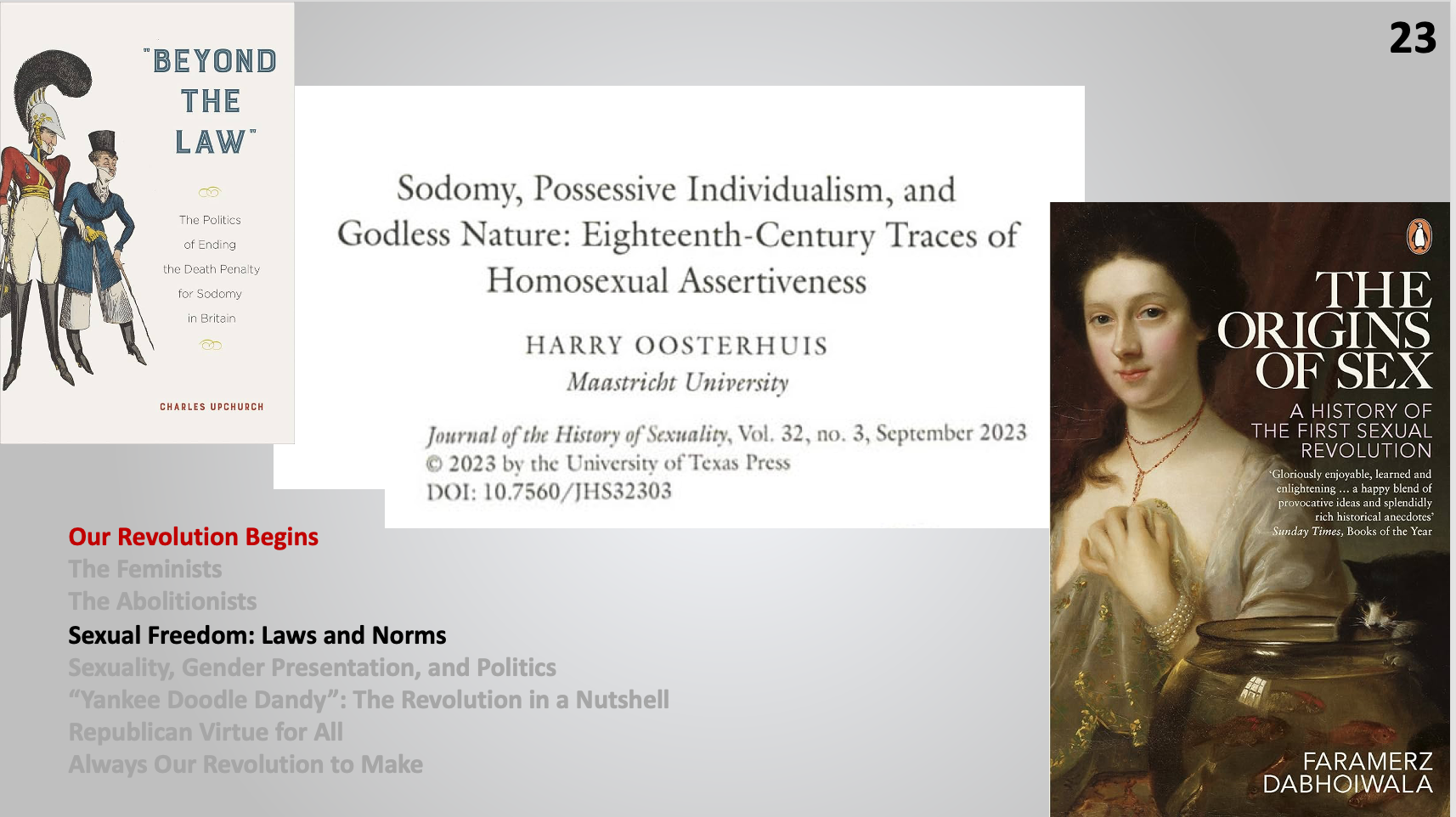
24 While there were many who defended the death penalty for sodomy – as a declaration of public distain – others, such as in a 1772 newspaper debate – argued that the laws were not needed –
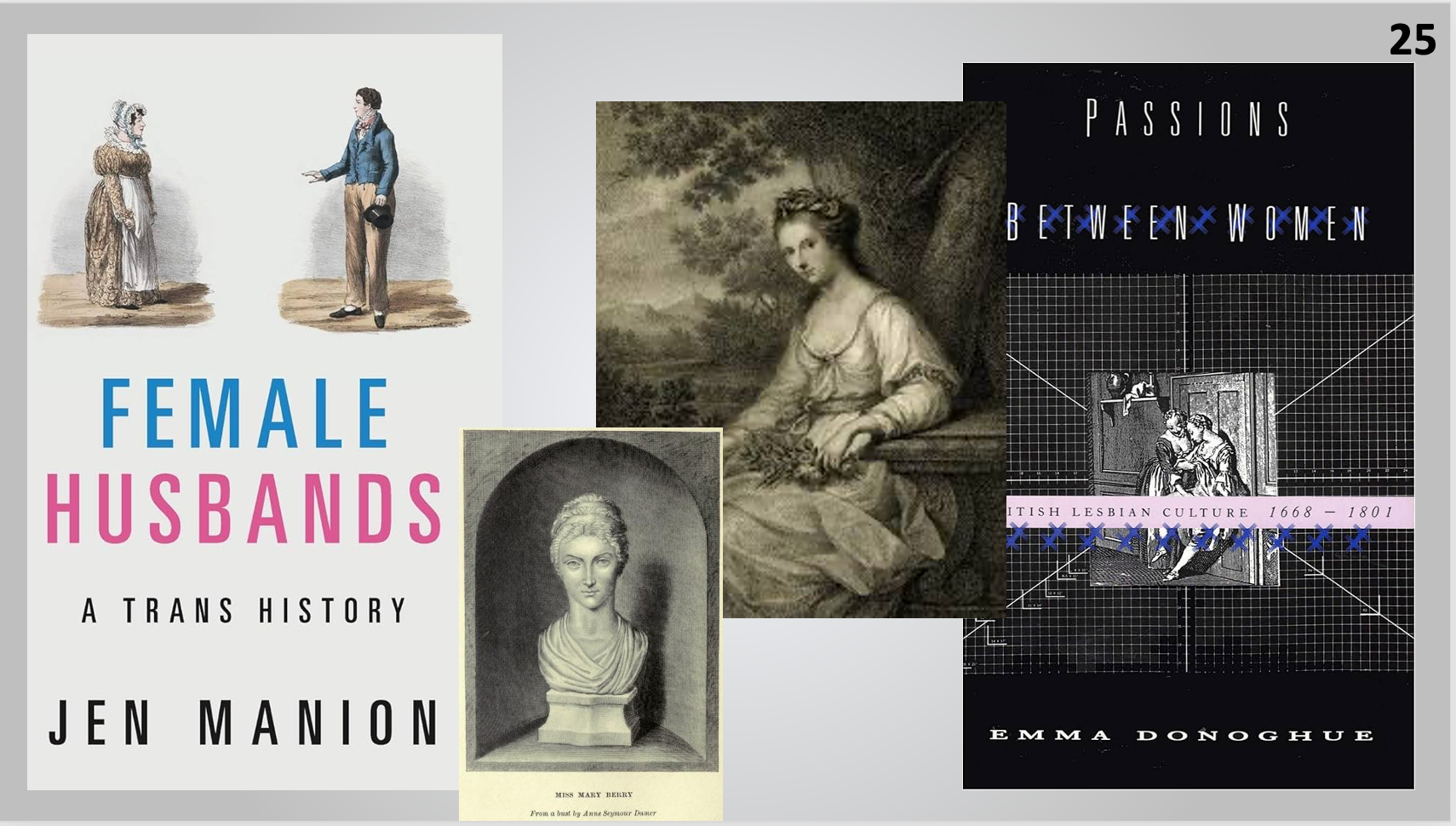
25 Sex between women was also discussed in the public sphere in the eighteenth century – as well as transing gender – but since neither of these areas were directly criminalized, the discussion did not have to center on changing laws – Sex between women largely only made it into the public sphere in stories to titillate men – or as a rumor spread about powerful women
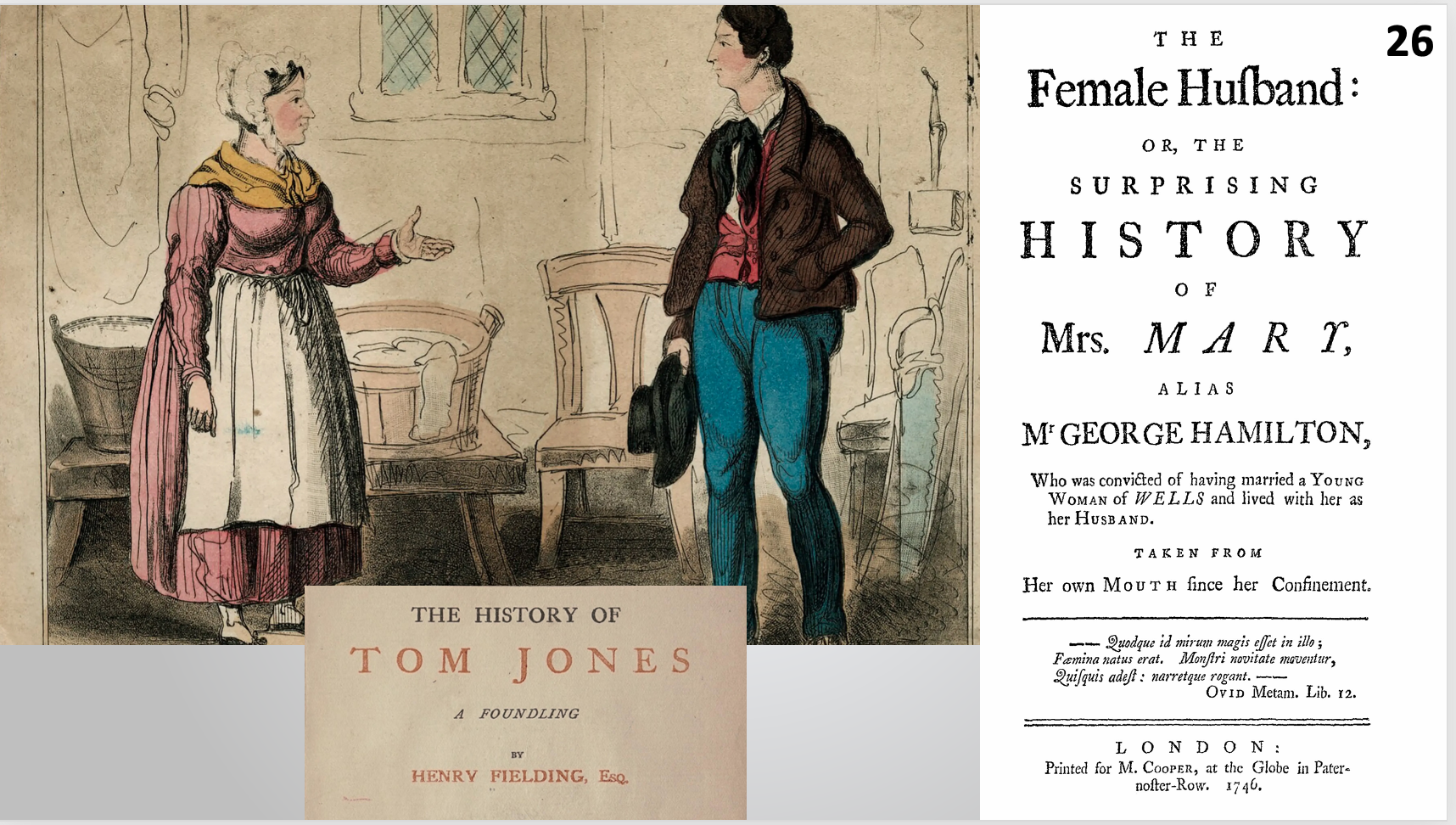
26 – Transing gender could sometimes be celebrated in the mid eighteenth century – The most popular novelist of the eighteenth century, Henry Fielding (author of Tom Jones), also wrote a work titled The Female Husband – about individuals who transed gender to live as men and marry women – and while in some cases such individuals were vilified as frauds, in other cases, if they had been upstanding members of their local communities, they continued to be accepted by friends and family even after their sex assigned at birth became known.
27 – And even though harsh laws against sex between men were on the books – there was nothing in the way of a modern police force – and just as today – people pushed fashion, and style, to send signals to others that would be missed by those not in the know – the Macaroni style was used in such a way – it could be the height of normative upper-class fashion – how young men coming back from two years on the Grand Tour showed their refinement
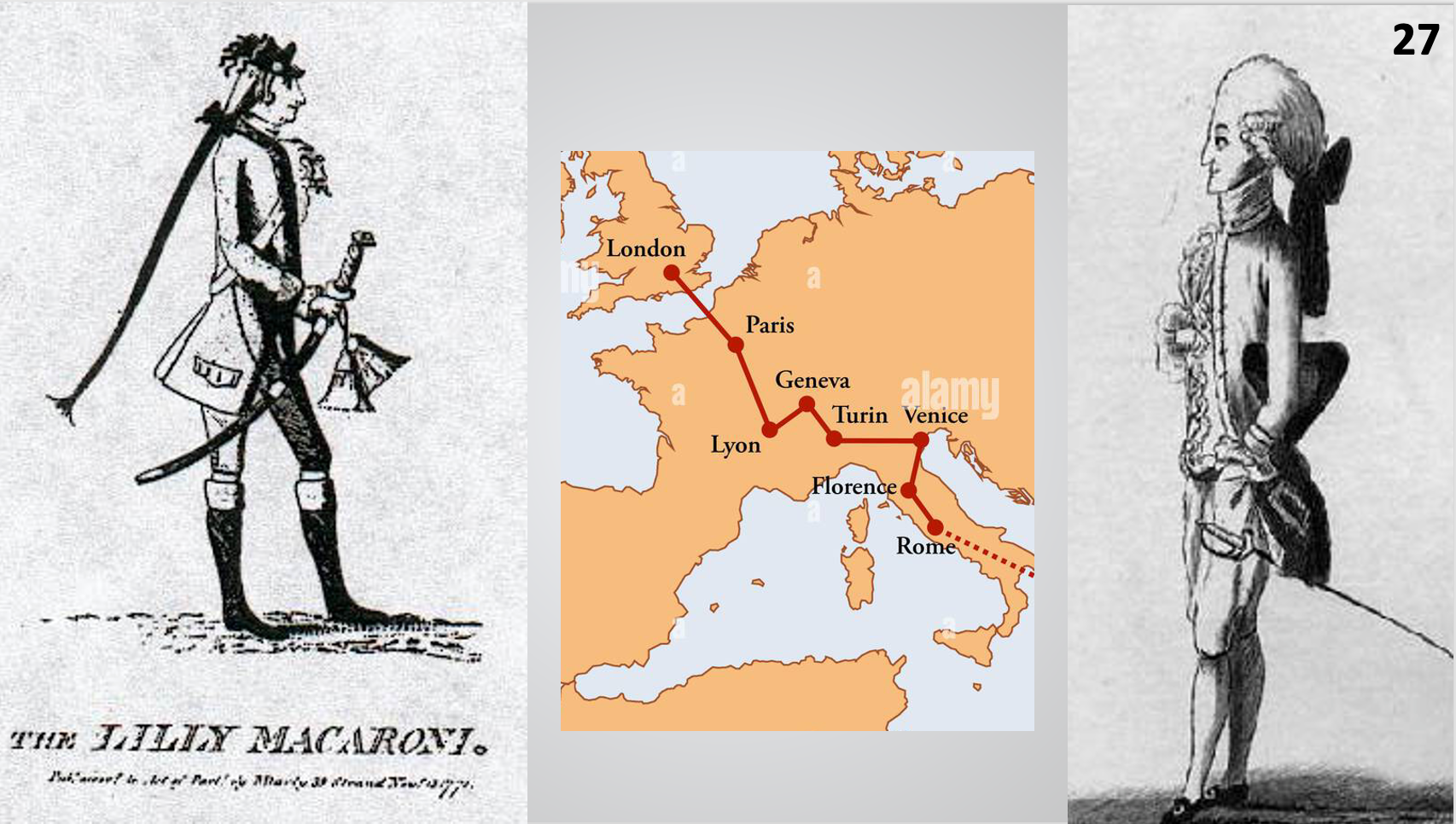
28 And just like todays high fashion styles – if taken too far, a person might be mocked – Many of these mocking images were not meant to imply same-sex desire – but were just poking fun at uncontrolled excess – a lack of self-restraint on the part of the wearer – which was a political critique as well as a personal one – which we’ll get to in just a minute –
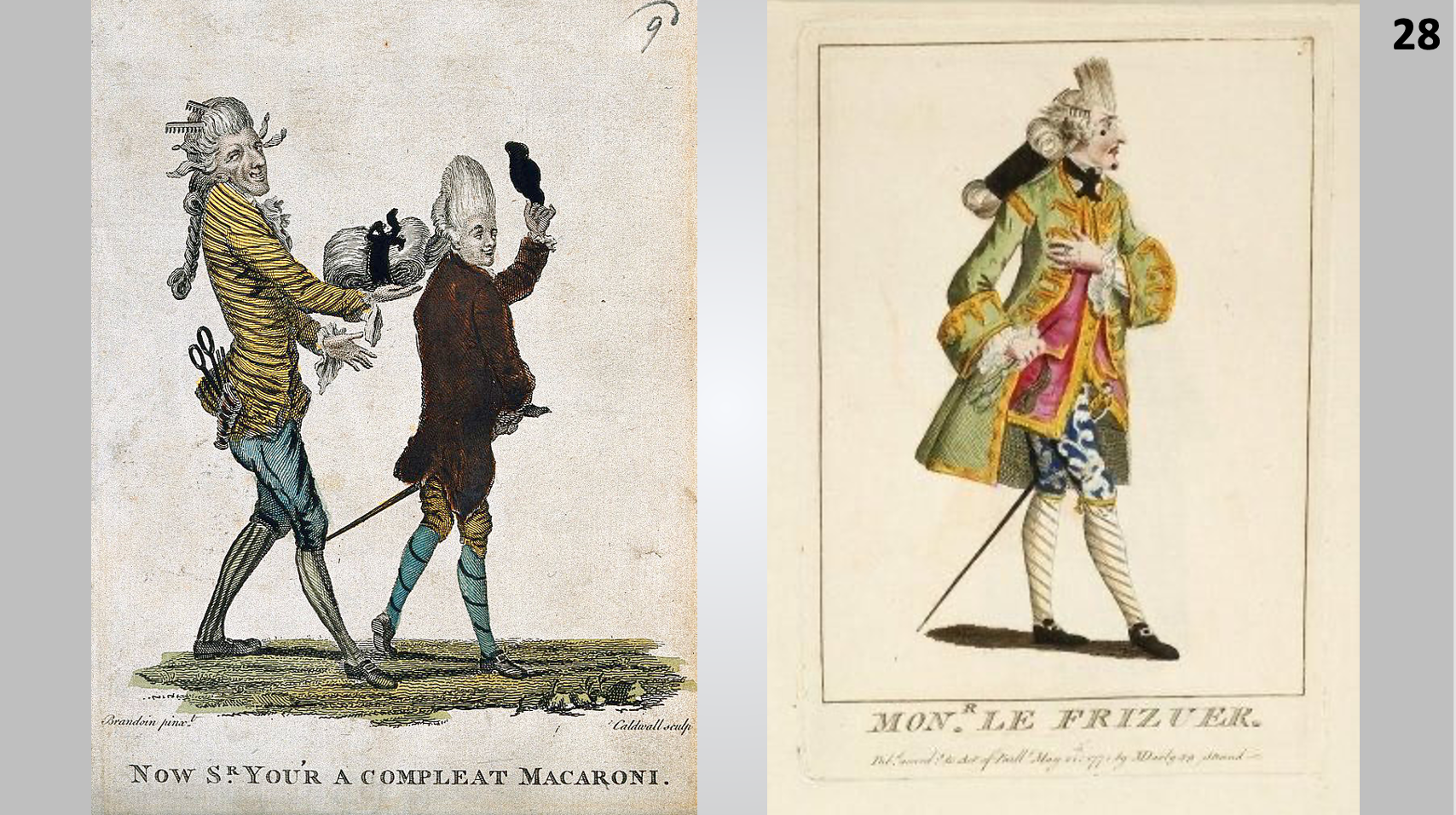
29 – But some of these images – such as these – were absolutely meant to imply same-sex desire on the part of the person pictured – Notice how the folds in the breeches of the individual on the left – just below his vest – look like a labia – this is no accident – subtle messages in images were central to political critique in this period – they let you imply, without stating outright – and so helped to prevent a prosecution for libel or sedition.
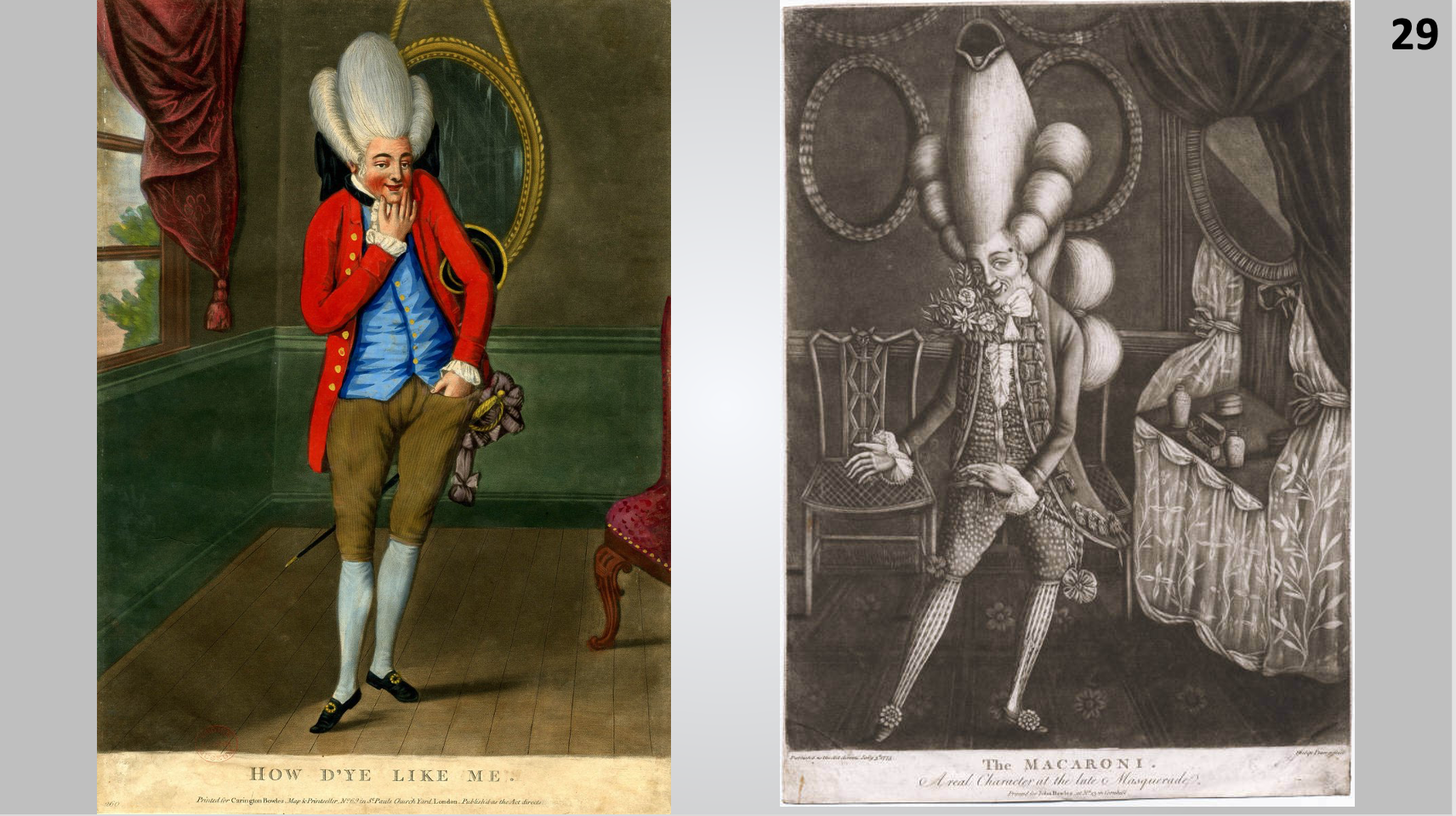
30 – This image directly critiques those purporting “Refind Taste” – in this case, a sensitive upper-class man is shown having emotional response to a beautiful landscape – But if you follow the gaze of the gentleman, and notice the angle and placement of the hilt of his sword – and where the shaft of the soldier’s sword crosses his body – you can read what the artist thinks that the refined gentleman is really interested in –
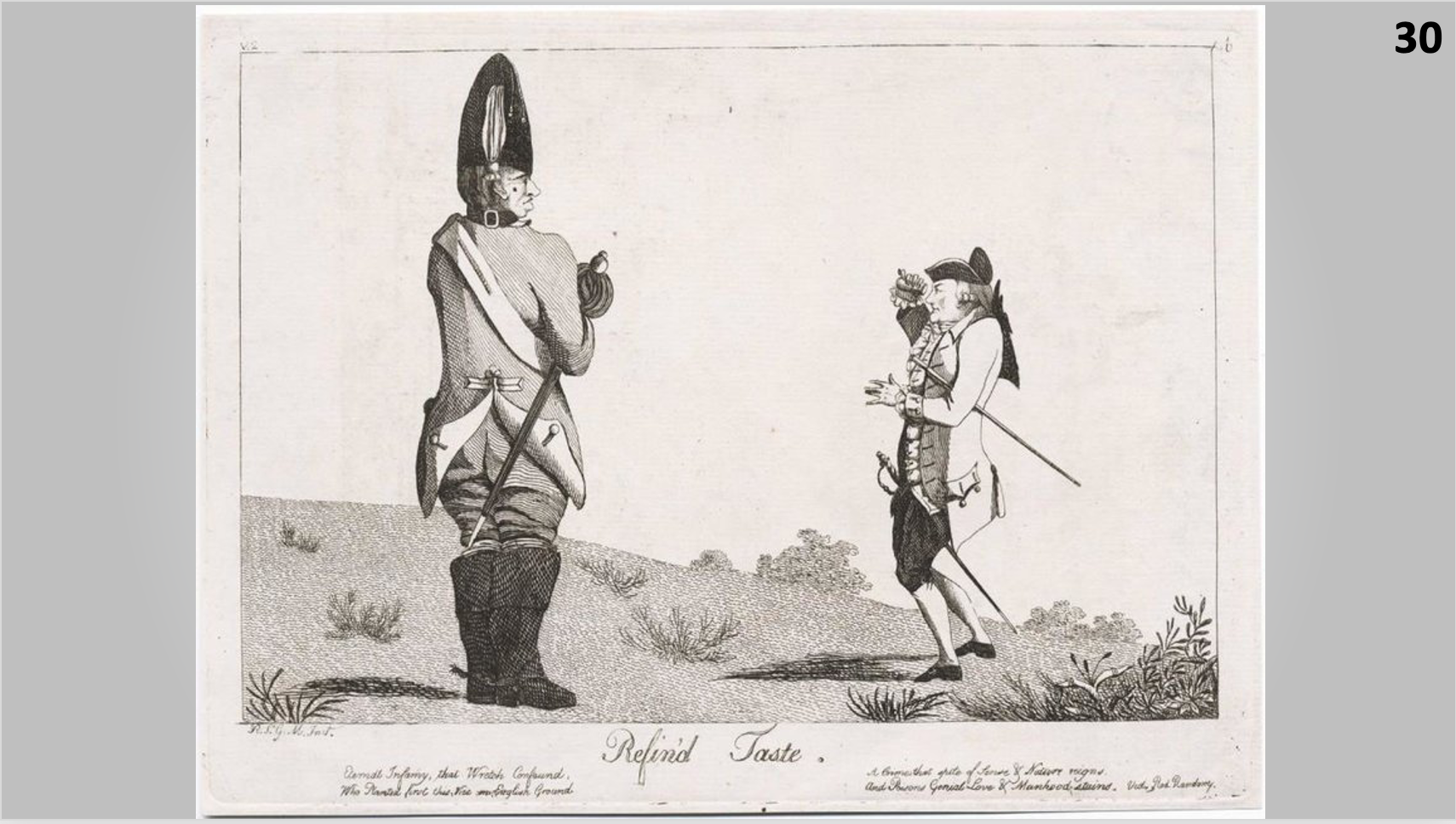
31 – And here as well – this image is titled a “Meeting of Connoisseurs” – and they are ostensibly interested in classical art – but notice the placement of the head of the cane – the indiscreet posture – and the fact that the open ends of the hats are turned to the viewer – carnal lust between men, rather than refined beauty – is the motivation that the maker of this print is implying.
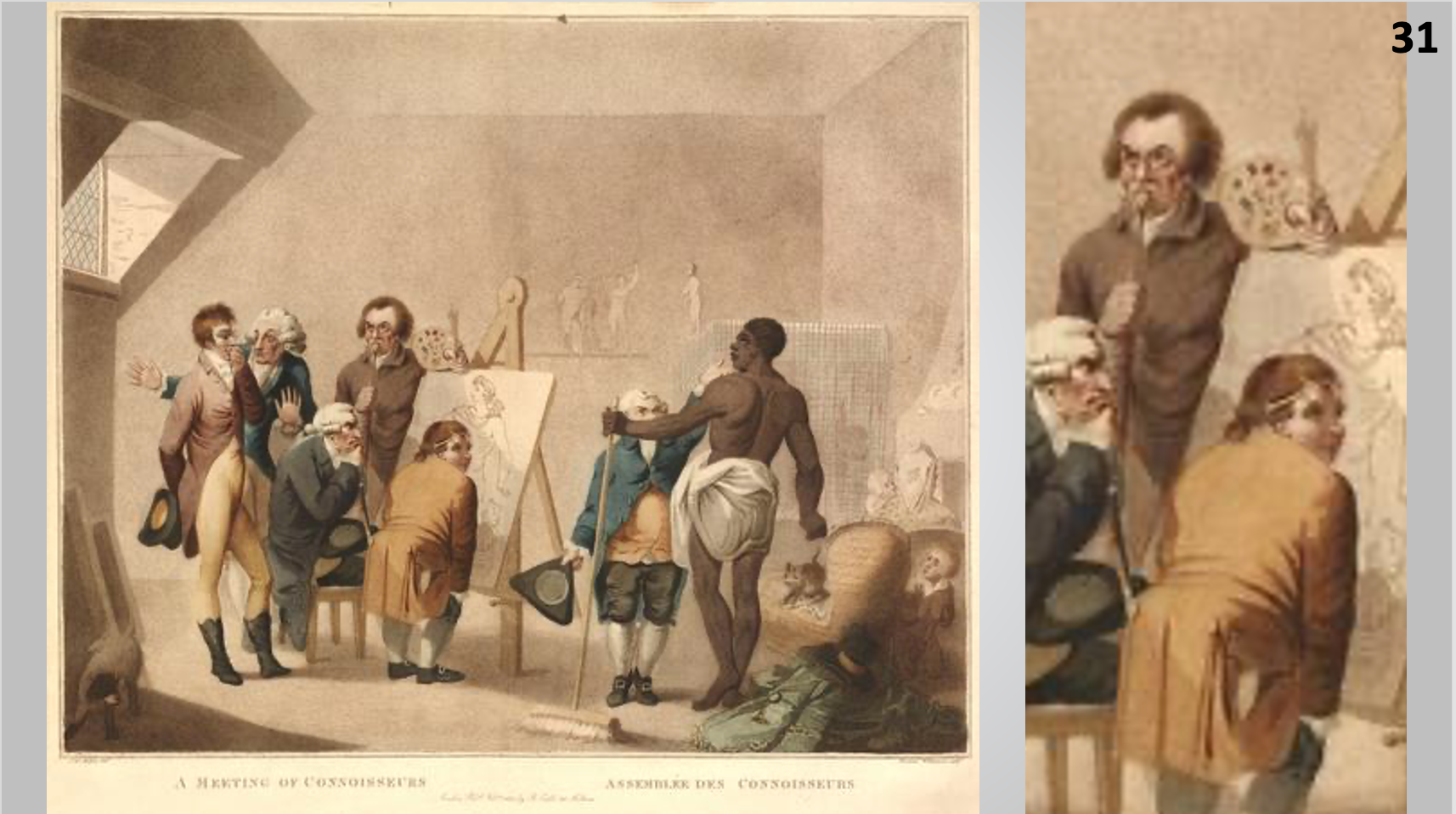
32 – Sometimes, these images were meant to be playful – such as in this image, where a father and son are reunited after the son returns from the Grand Tour – The father is surprised, but not infuriated – the son’s dress is depicted as exaggerated, but he’s not assuming it represents a break with his father or his father’s values
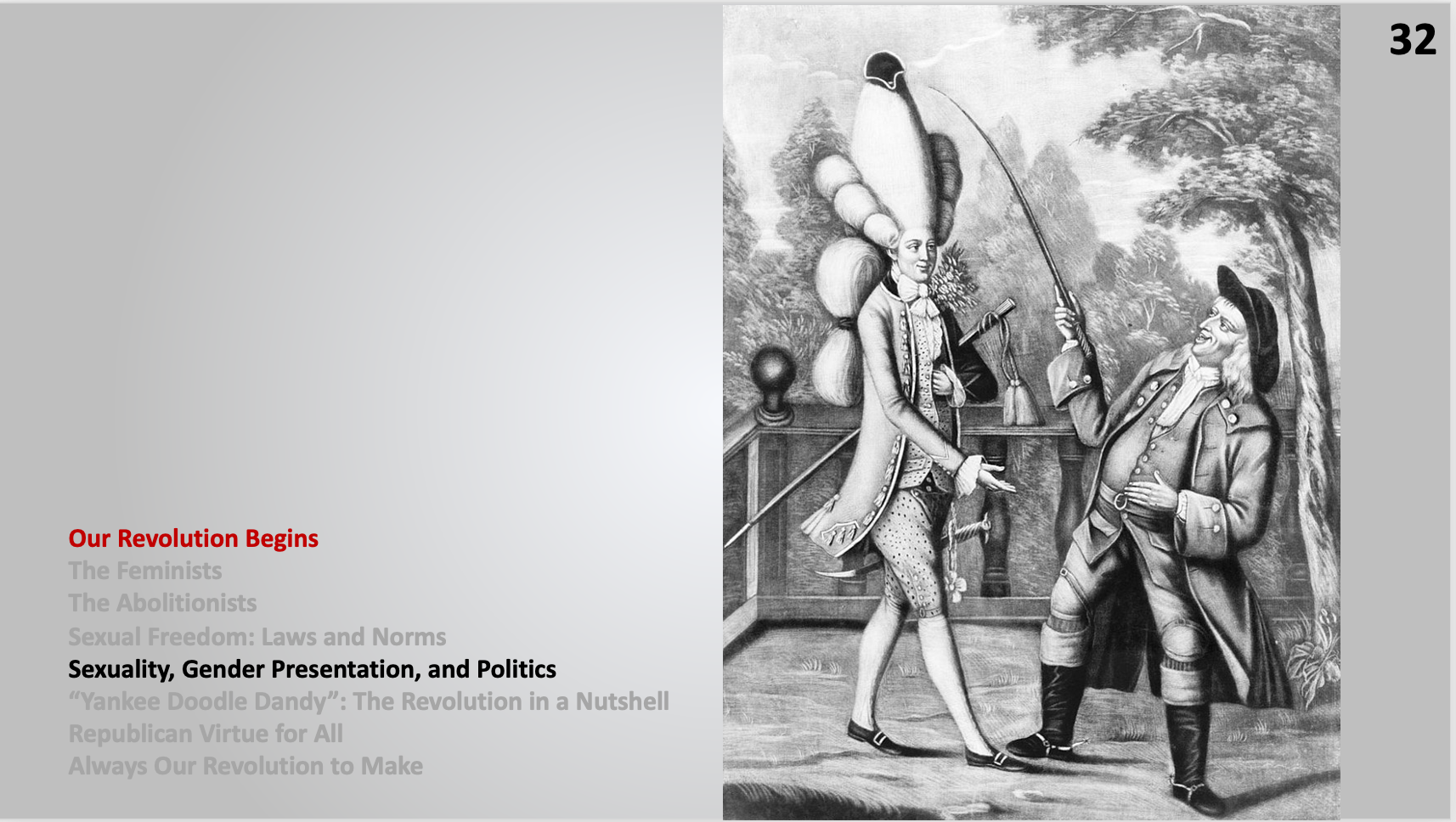
33 But this juxtaposition – of the rural simplicity (perhaps shading into buffoonery) and courtly refinement (perhaps shading into effeminate luxury) – was a central political metaphor in the eighteenth century – both in Britain itself, as well as in the Thirteen Colonies – and especially for the period surrounding the American Revolution
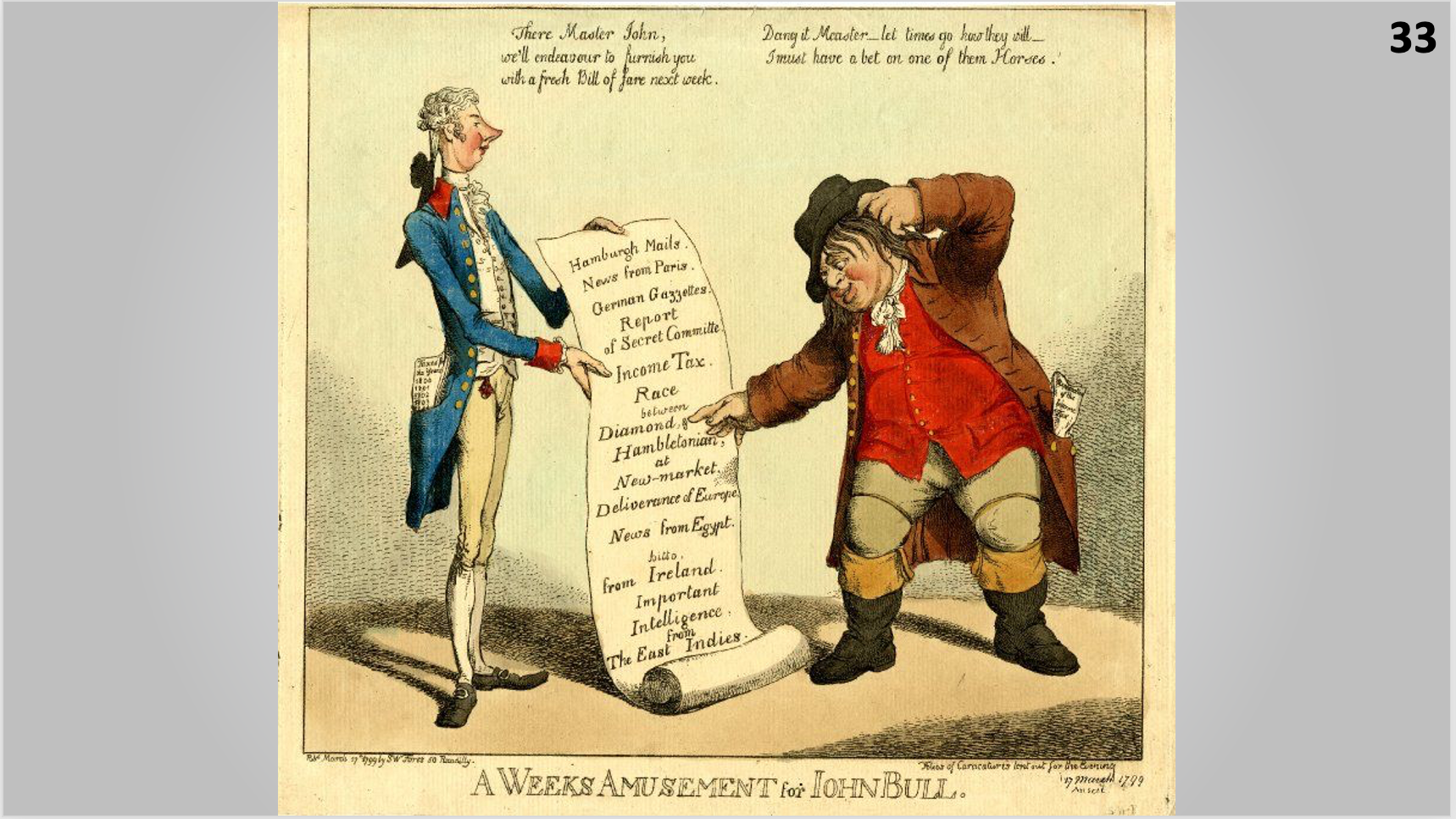
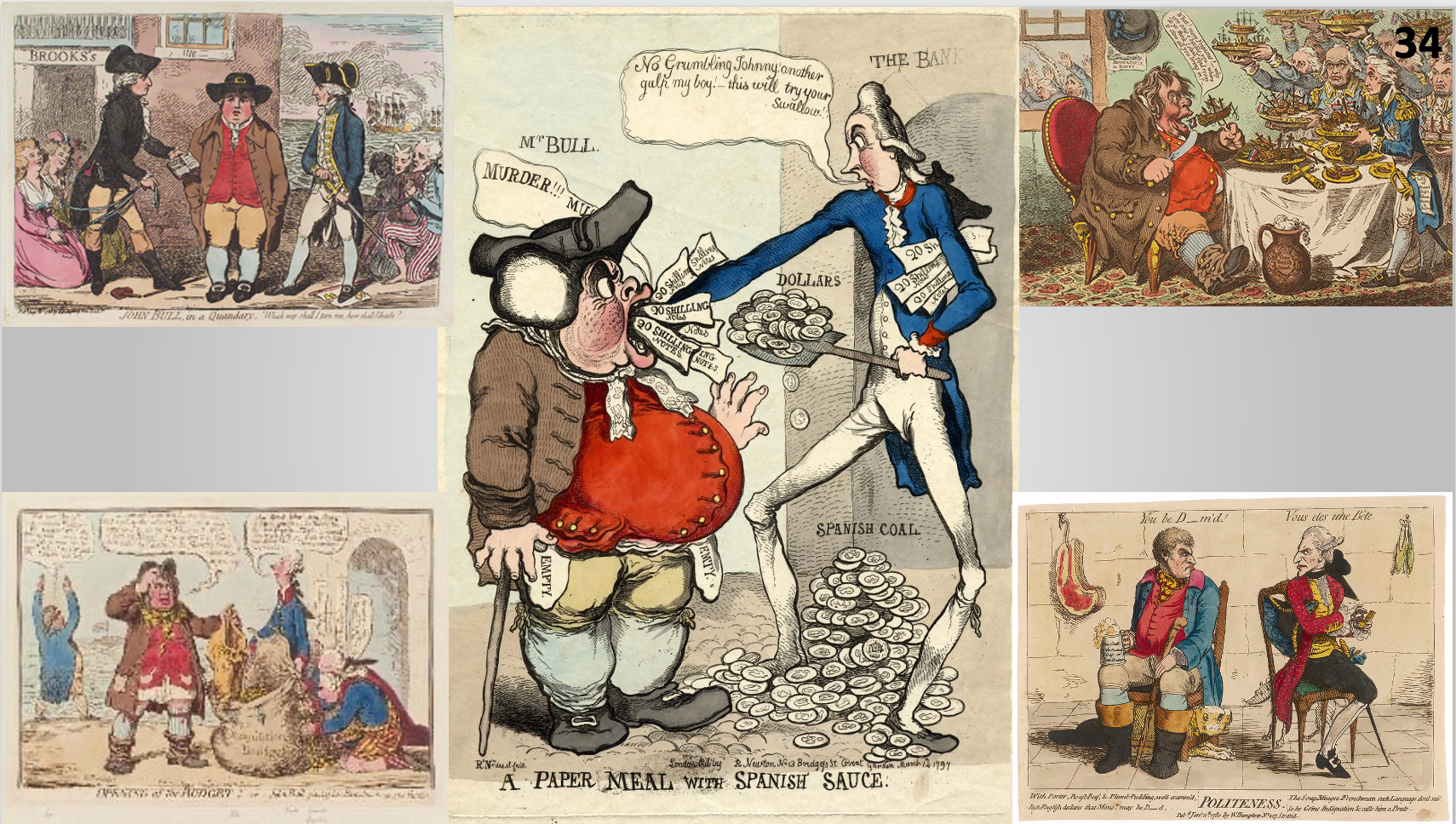
34 The simple country Englishman – exploited by a privileged minority who lived in luxury off of the taxes of those who worked – was a stock figure in British public sphere. Americans often forget that there was a huge contingent in Britain itself who agreed with the Colonists’ critique of the British ruling class – and felt that if the British government could raise revenue illegally in the colonies – then that revenue could be used to suppress liberties back in Britain itself
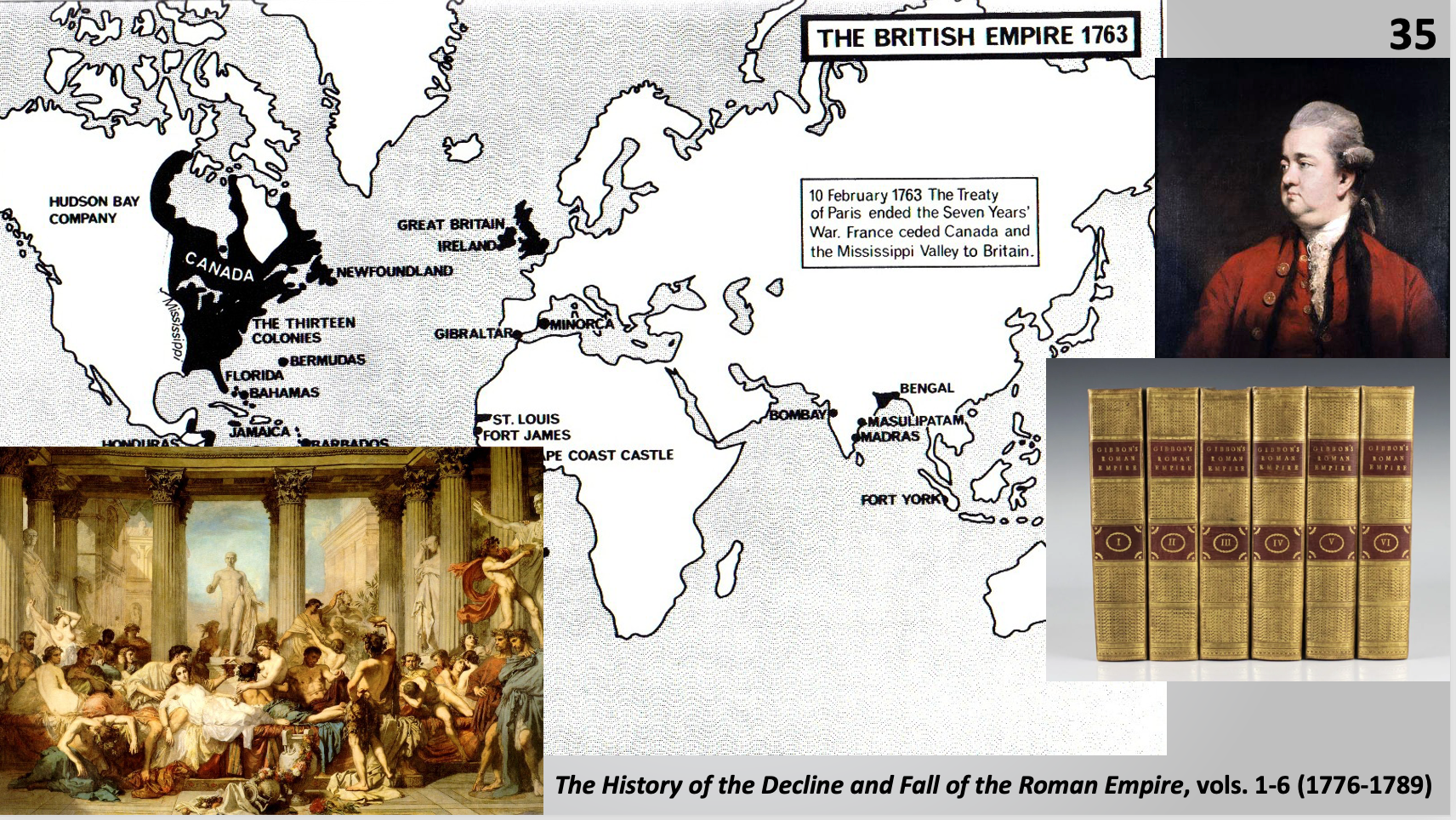
35 This contrast over masculine gender norms in the political sphere also had a sexual component that was central to it – That’s because the upper class were aware that excess wealth could lead to luxury – decadence – corruption – and bad government. This was the lesson they took from the fall of the Roman Republic – after Rome conquered the Eastern Mediterranean, an influx of wealth from those lands corrupted the virtue of Rome’s elite families – Many Britons feared that wealth from the Caribbean – or from newly conquered territories in India – might likewise lead to corruption and despotism in Britain itself.
36 And yet – the commercial revolution – which the state was cultivating – was fostering luxury for more and more individuals – consumer spending drove economic growth – and was good for business, but it might also be detrimental to morals. The solution to this offered by the Whig Oligarchs and their upper-class allies, and also the reason they gave for why only they should run the state – was their virtue – which came from generations of breeding and privilege. A refined upper-class person, they said, from a family steeped in such privilege for generations – had the fortitude to be exposed to luxury and not be corrupted – while a lower-class person – with no such experience or resources – would be overwhelmed when exposed to luxury, and so must avoid it.
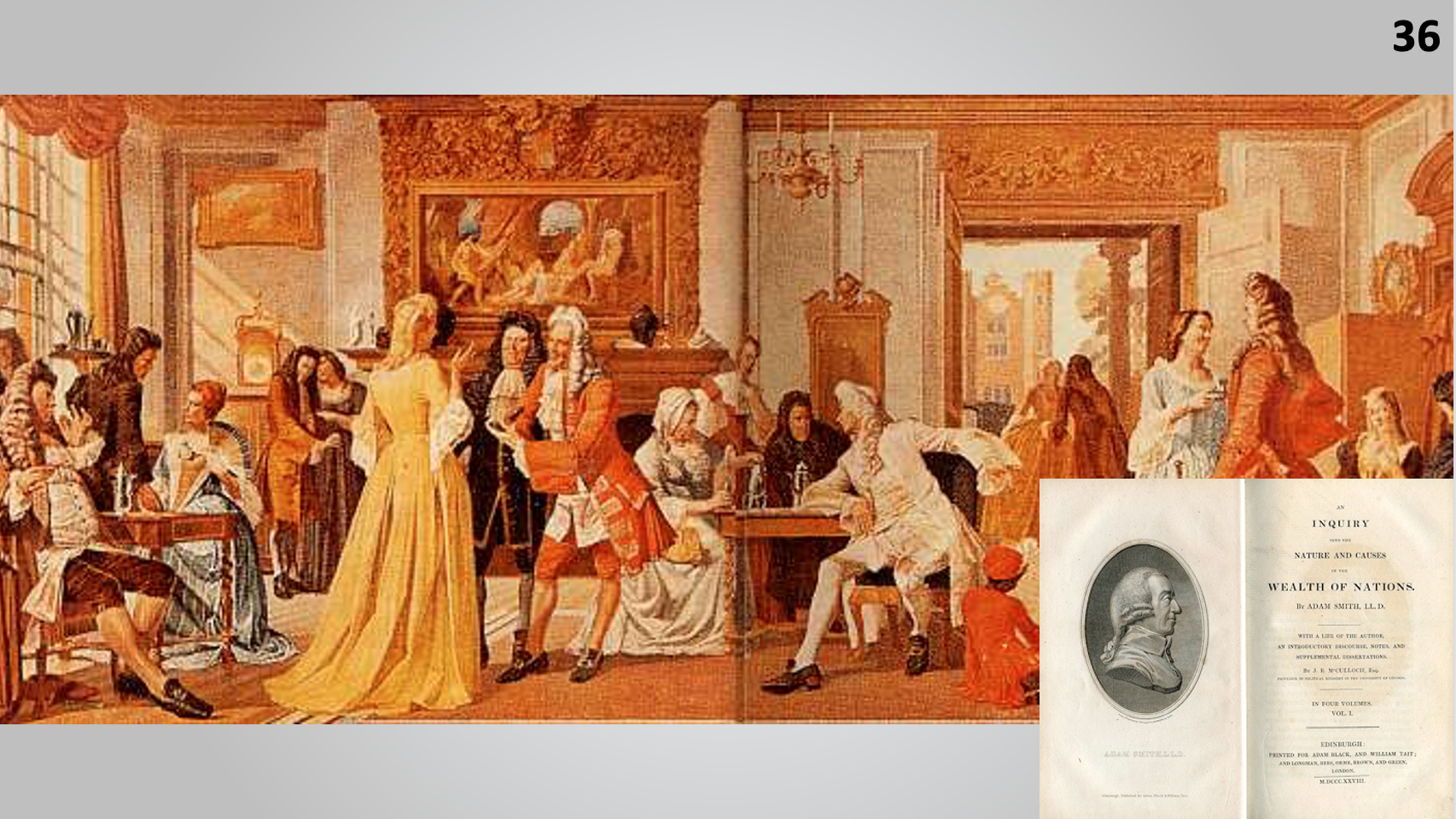
37 Enlightenment political theory, on the other hand, held out a more democratic solution – all people were born the same, and could be educated in their lifetimes to rule themselves – Republics can only function with republicans – individuals who educate and discipline themselves to be self-governing – And every major political thinker of the period – who theorized a state where people ruled themselves – also had a theory of educating individuals – to make the kind of person who could exercise the self-control to make a republic possible – A king said it was your blood that made a ruler – an oligarch said it was your breeding – but Locke, Rousseau, and Wollstonecraft said you made yourself into what you needed to be to participate in the running of the state.
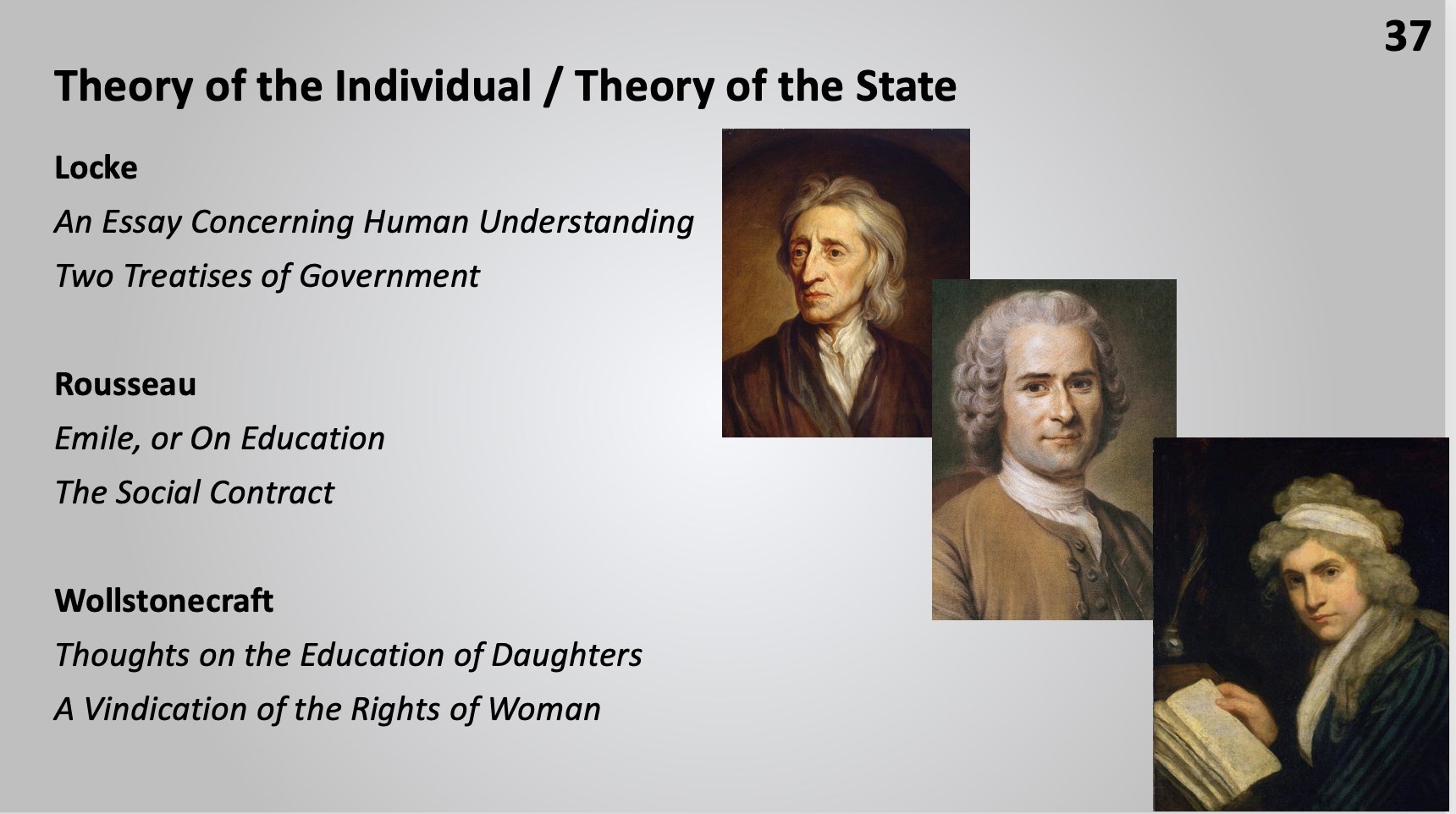
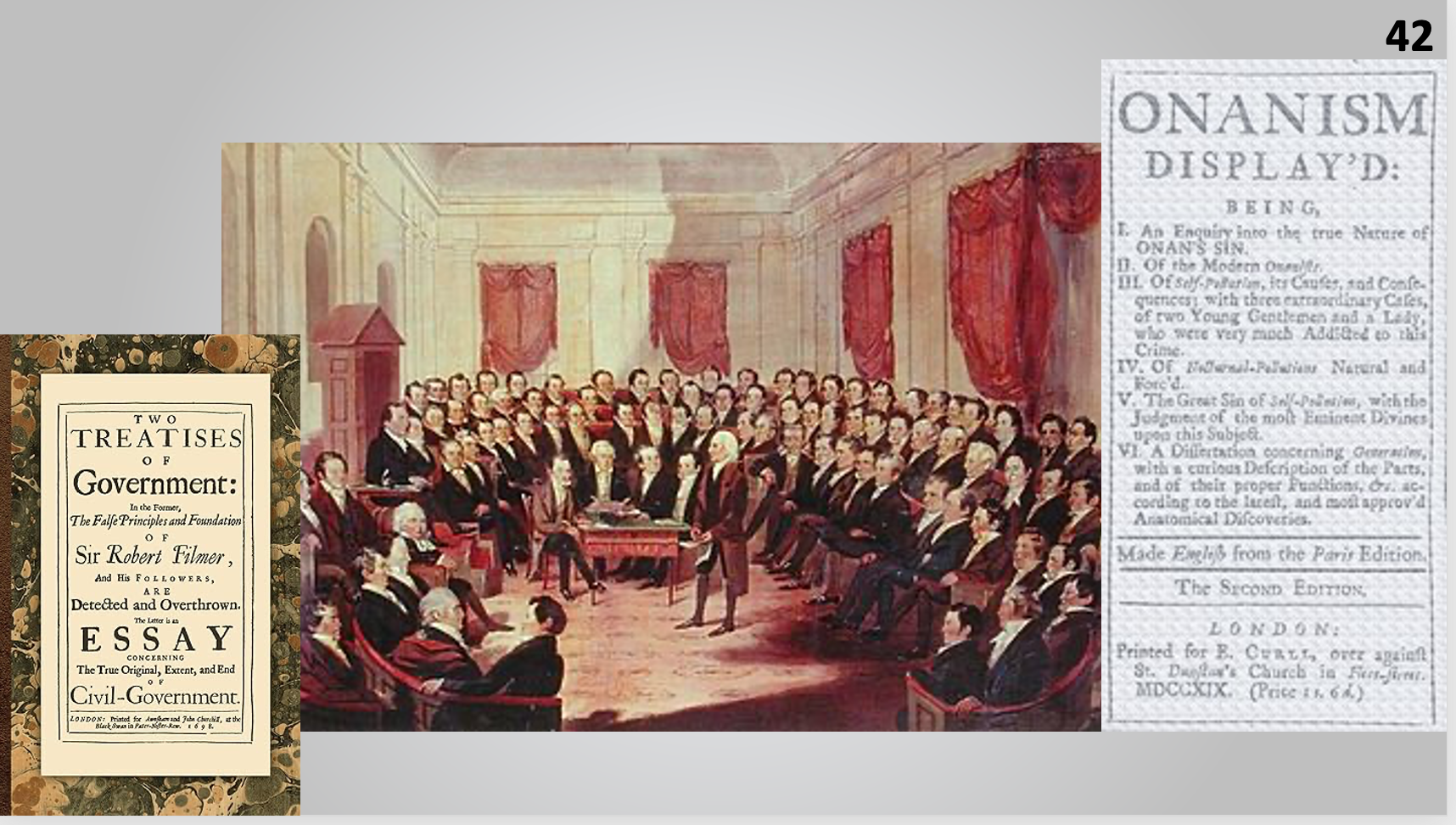
38 And it’s no accident that the age that saw the greatest debate about how people might govern themselves – also saw the first widespread panic about masturbation – Because masturbation is the flip-side of the Enlightenment self-governing individual – the cautionary “other” of where all that freedom might lead – The freedom to pursue your own happiness, without having to heed the laws of the king, or the morals of the bible – might lead folks to become exhausted, antisocial, self-pleasurers – As much as some in the period disparaged sodomies, some say the culture thought masturbators were worse, because at least sex between men was social – and not solitary – Too much freedom might be bad – The other of the republican citizen was the masturbator.
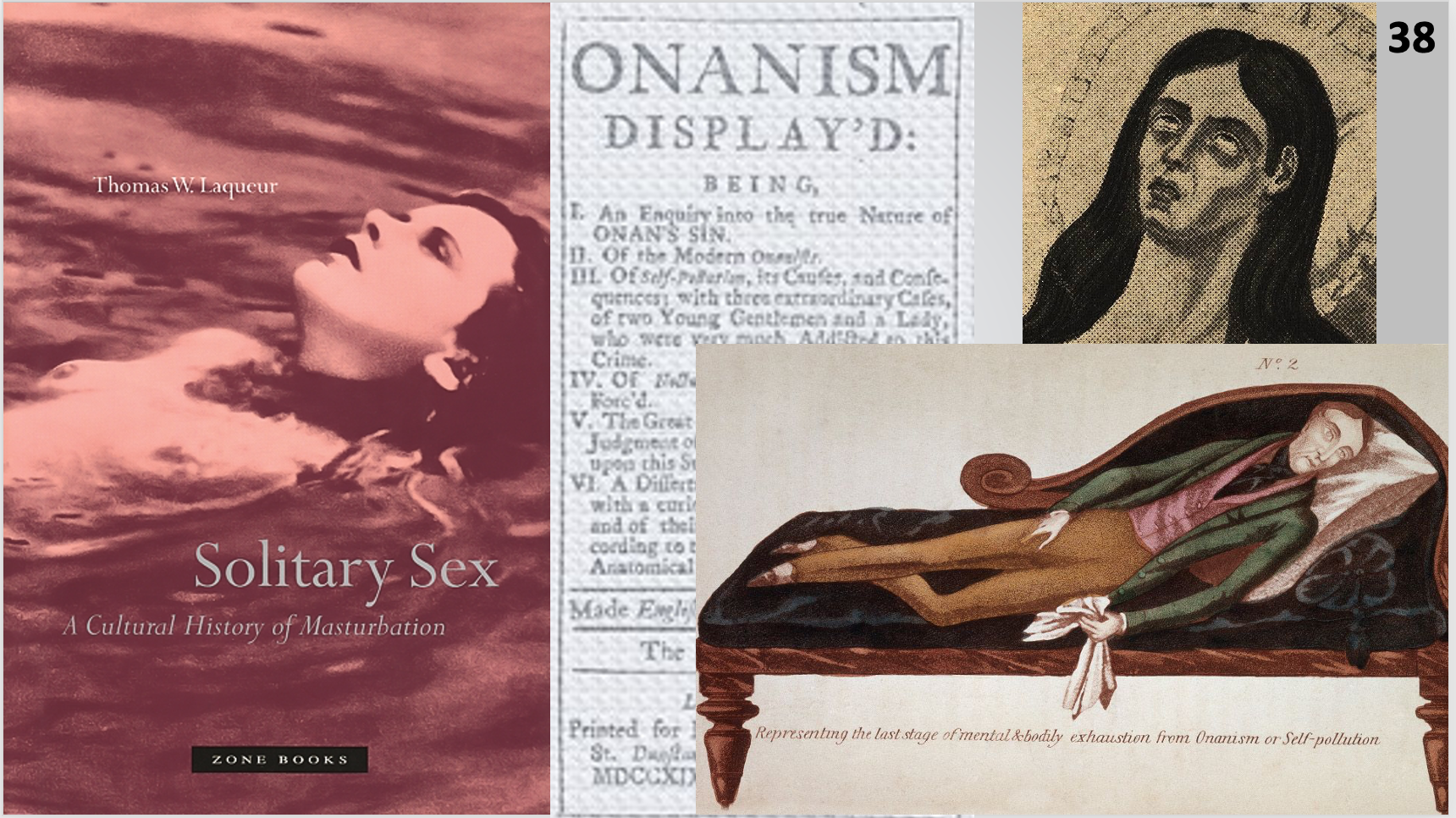
39 And now – finally we have all pieces to understand Yankee Doodle Dandy – and why this song encapsulates so much of what was at stake in the American Revolution. The song “Yankee Doodle” is fundamentally about these clashing ideas of virtue – and self-control – and sexuality – and masculinity – There were hundreds of different versions of it – but it started as a British song – and a British critique of the rube-ish Americans, who presumed to have the ability to rebel and rule themselves.
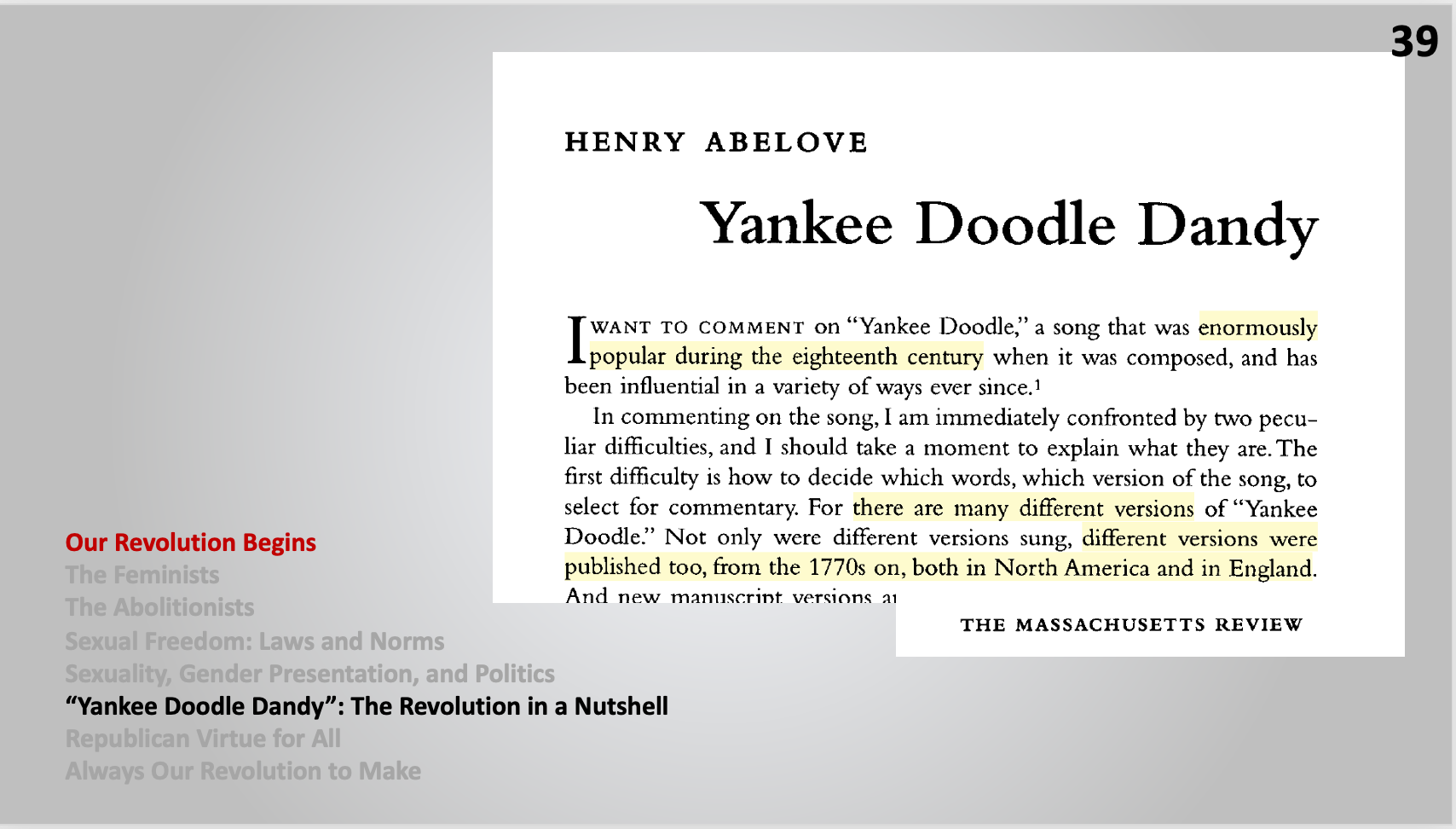
40 The lyrics follow an American father and son who go to General Washington’s camp to volunteer, and the British lyrics contain puns and innuendos about how these unrefined country folk, as well as their leaders, are comic in their cluelessness of their own inadequacy – When Yankee Doodle sticks a feather in his cap and calls it “macaroni” it only shows how simple he is, to think that this is enough to be refined – Lack of virtue and refinement also led to a lack of self-control – being impulsive enough to rebel against rightful authority – and impulsive enough to pleasure yourself – there are a range of masturbation puns in various versions of the song –
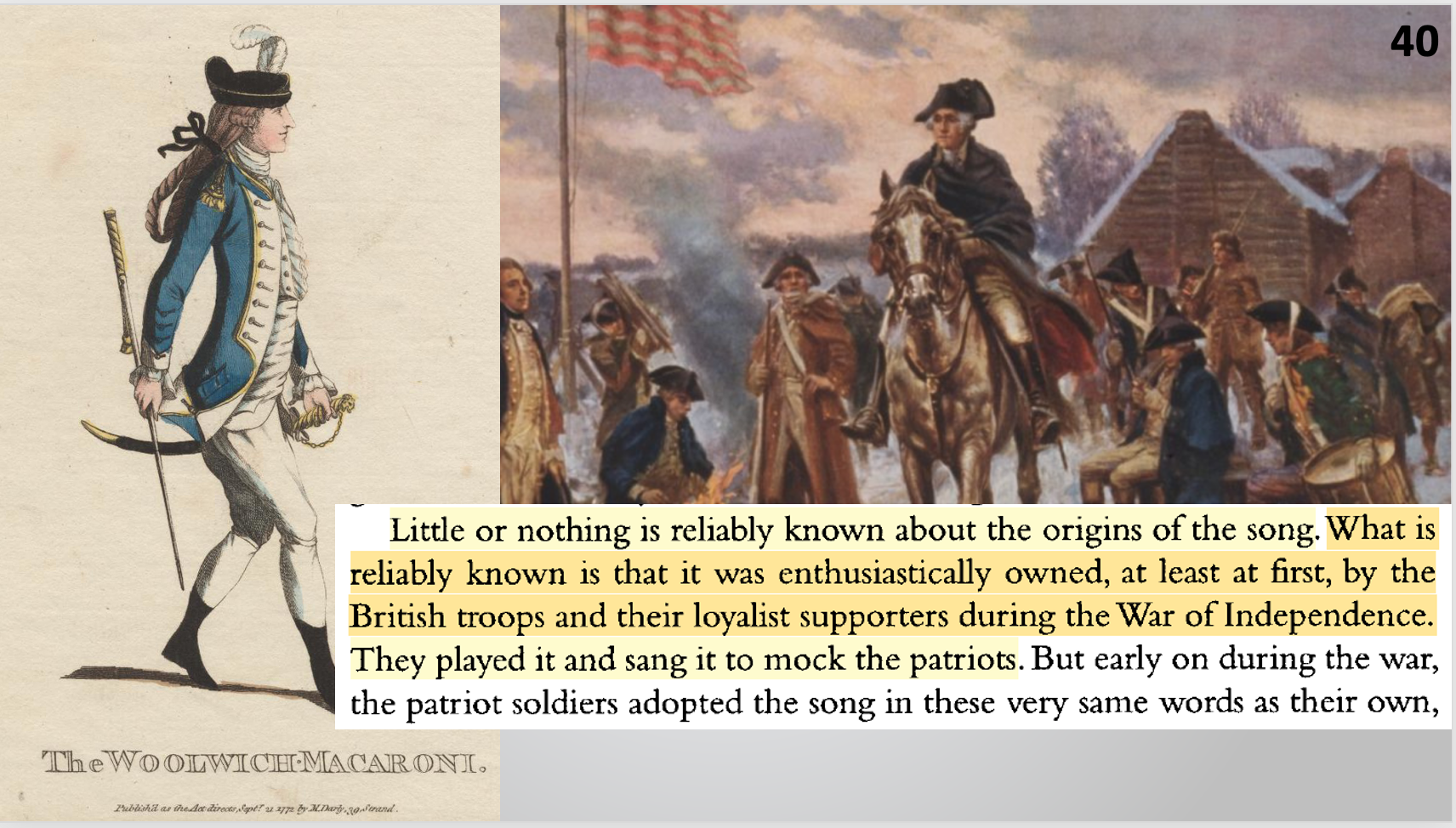
41 And yet Americans took up the song – and made it their own – taking what the British elite called out at faults – and holding them up as virtues – Americans were not overly sophisticated – and foppish – and their virtue came from their rural simplicity – They were educated through their own public sphere, in the ideas of Locke and others that had been debated vigorously in the colonies ever since the end of the Seven Years War – when the British Parliament began to try and tax the colonies directly – and the colonists had to articulate why exactly that was unjust. – Americans were young – and vigorous – and with enough vital energy even to self-indulge on occasion – and still be in control of themselves, and still be more stalwart that the courtier elites of Britain – Besides Lockian philosophy gave the government no power to regulate sexual pleasures – so what they did on their own time was their own business.
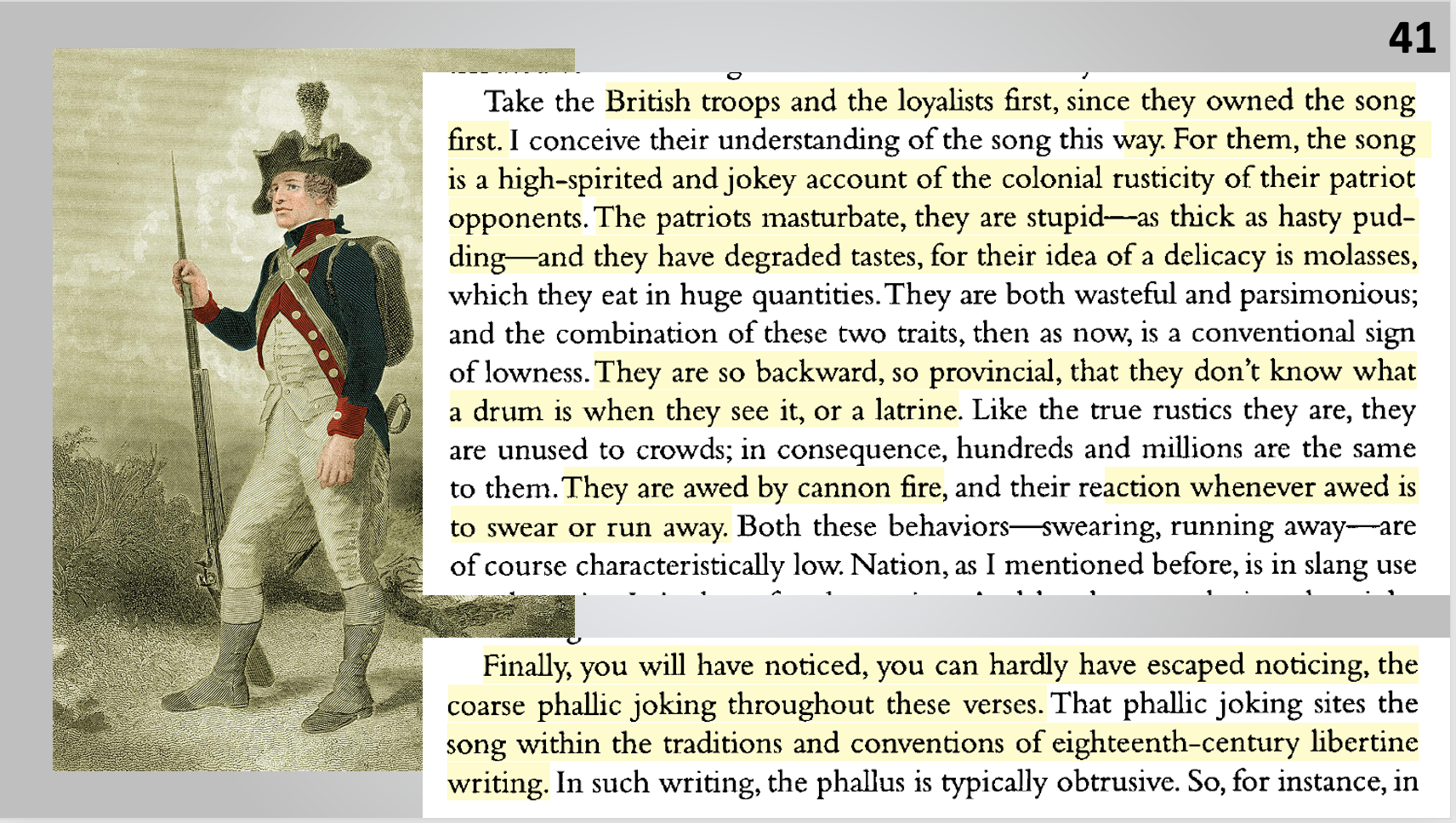
42 In these ways – the ideals of a free and self-governing people were tied to sexual politics – Each individual had to learn the moderation and restraint necessary – to fulfill his duties as a citizen – and not encroach on the rights of others – In the same way individuals had to self-regulate in their consumption – and in their indulgence of their tastes and pleasures – disciplining themselves to not overindulge, while also being left free to do what one wished within those parameters – Sexual freedom is a necessary component of liberal individualism – The logic that established one necessarily includes the other – they cannot be separated – Our freedom – around gender and sexuality – is tied up with the basis of the freedom of all Americans – being self-governing republican citizens.
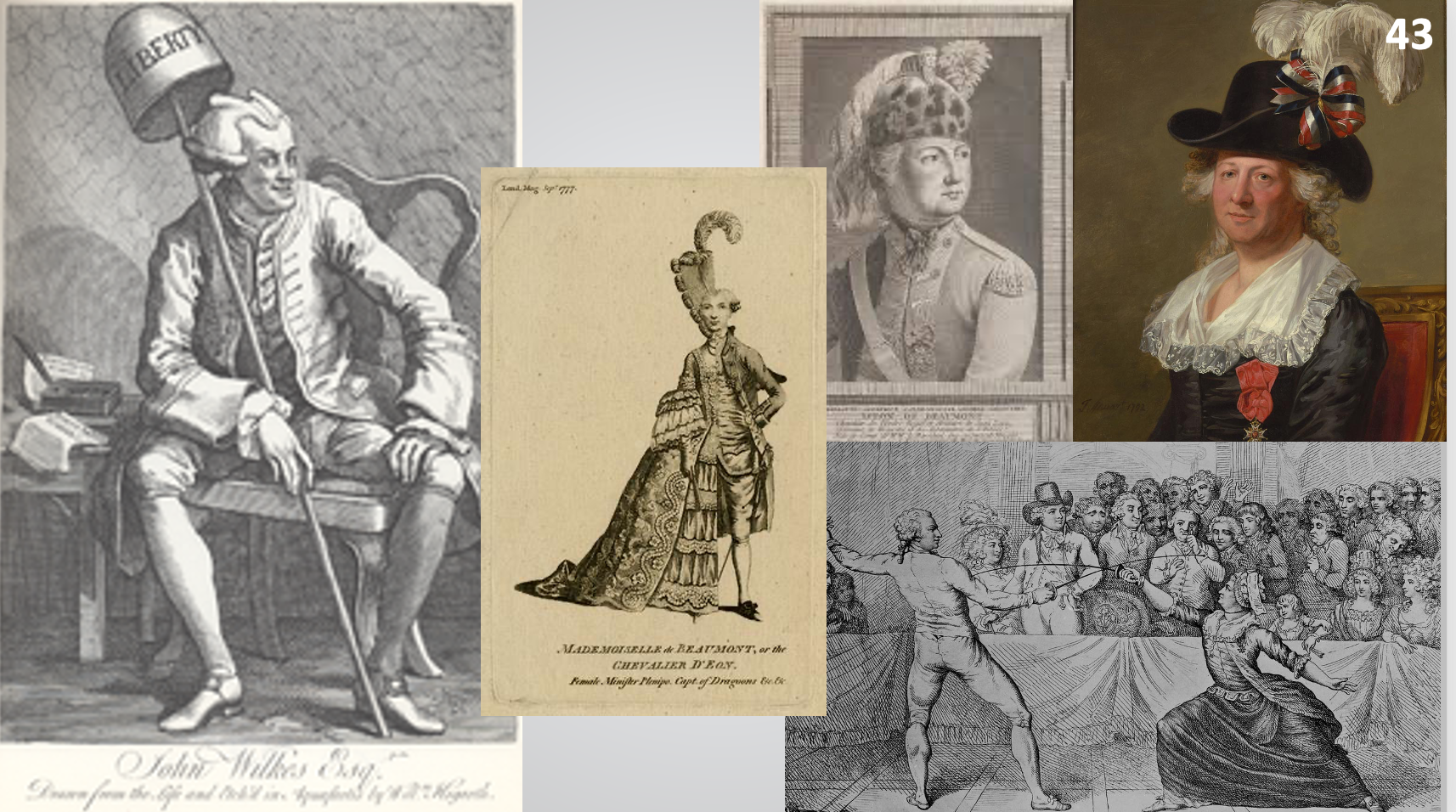
43 This linkage between sexual freedom and the ideas of Locke – and the governments based on those ideals – was also central to the debate on political freedom in Britain throughout the eighteenth century – men like John Wilkes – a member of the British Parliament from the constituency in Britain that had the most democratic rules for who could vote – clashed repeatedly with the British government, and sided with the American colonies – he was a hero in the Thirteen Colonies – and he was also known for flaunting his libertine sexuality – as a necessary component of his critique of political oppression – he was also great friends with the Chavilier d’Eon, one of the most famous individuals to trans gender in the eighteenth century – and who became a British celebrity for doing so
44 – Now – Given more time, I would develop these arguments a bit more – but we already have enough to support my main points – that the greatest tools that we have for fighting the longstanding injustices in the world are a free press – where ideas can be debated – and a political system not based on hereditary right – but on the ability of individuals to rule themselves – Those principles were partially established in Britain after 1688 – to justify one rebellion – and were far more firmly established – and enshrined in a written constitution – as a result of the American Revolution of 1776 – It was a contract that specifically did not give that new state the right to set up a national morality – leaving most aspects of gender and sexuality to private choice.
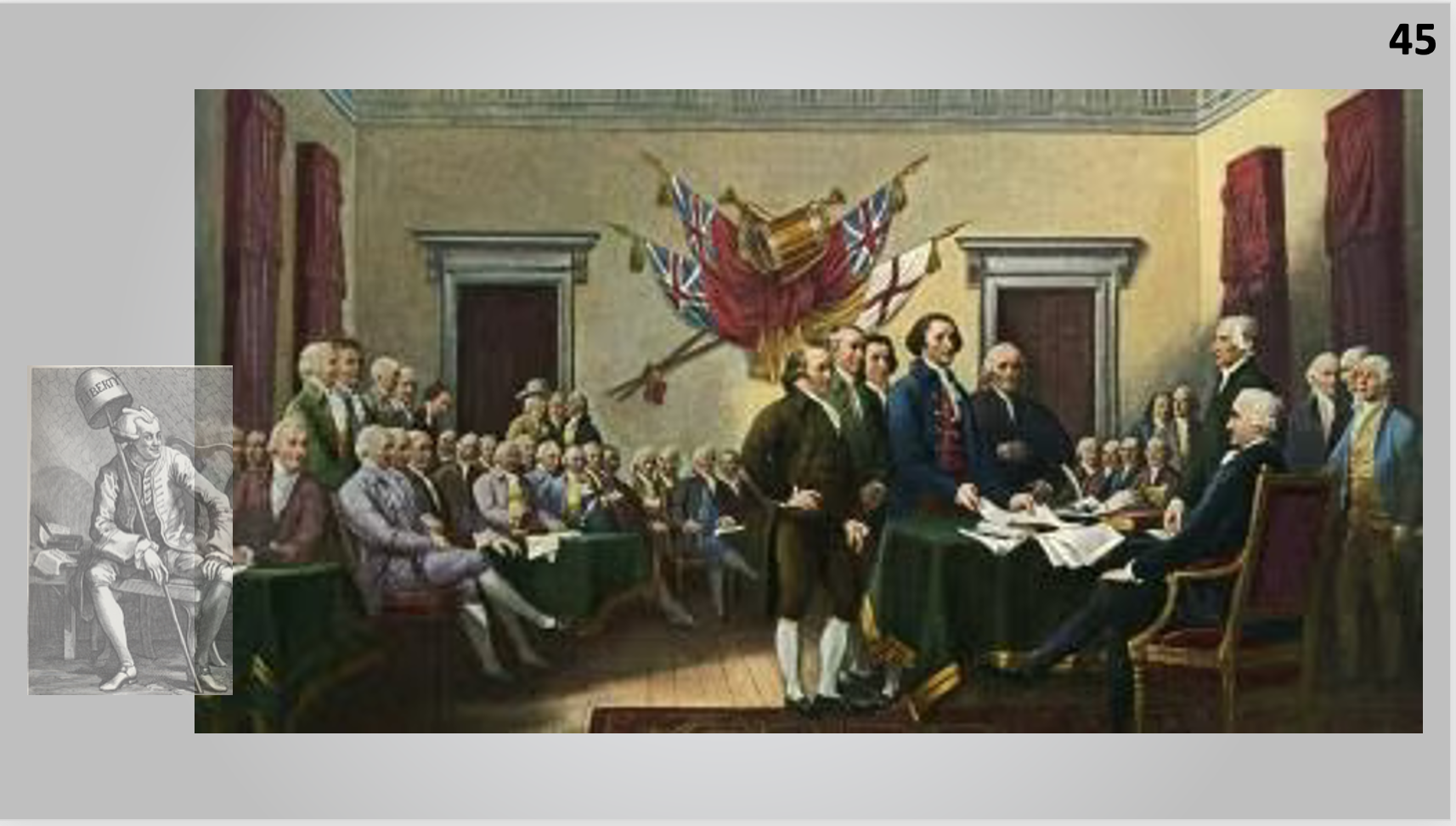
45 – Many of the people in the past who forged these tools were deeply flawed – often focusing more on the injustices being done to them – rather than the injustices that they perpetrated on others – But the same will almost certainly be said of us, in the future, as well –
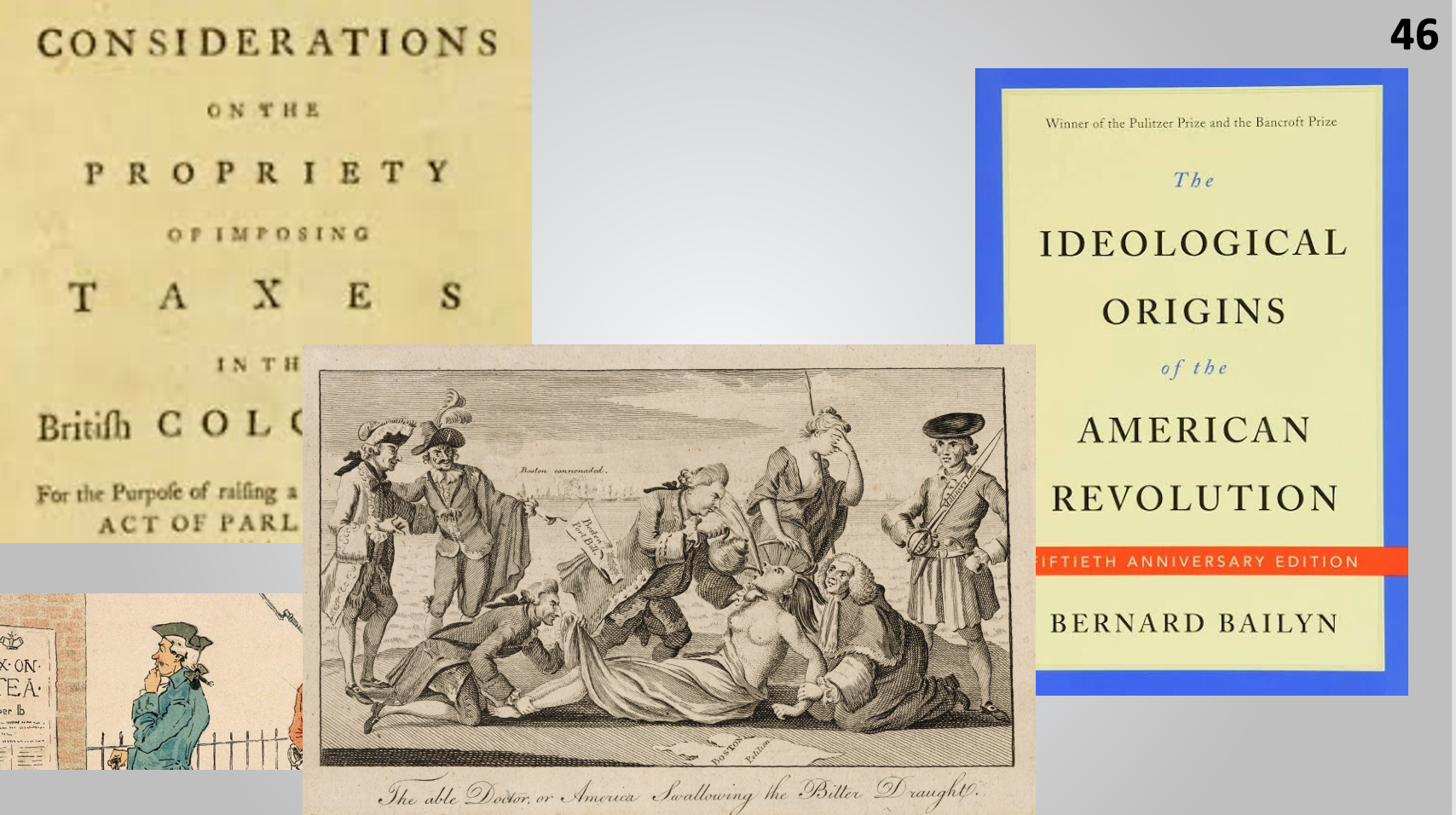
46 – And we should also remember that many of these individuals in the 1760s and 1770s were also brave enough to follow the ideals they professed to their logical conclusion, even when that went against their economic interests. In the twenty years of debate that preceded the American Revolution – where the colonists argued in pamphlets and newspapers over the issue of who had the right to tax them, and who did not – and what was fundamental to the nature of a just government – A rhetoric quickly developed that to submit to unjust and tyrannical government reduced free men to the status of slaves.
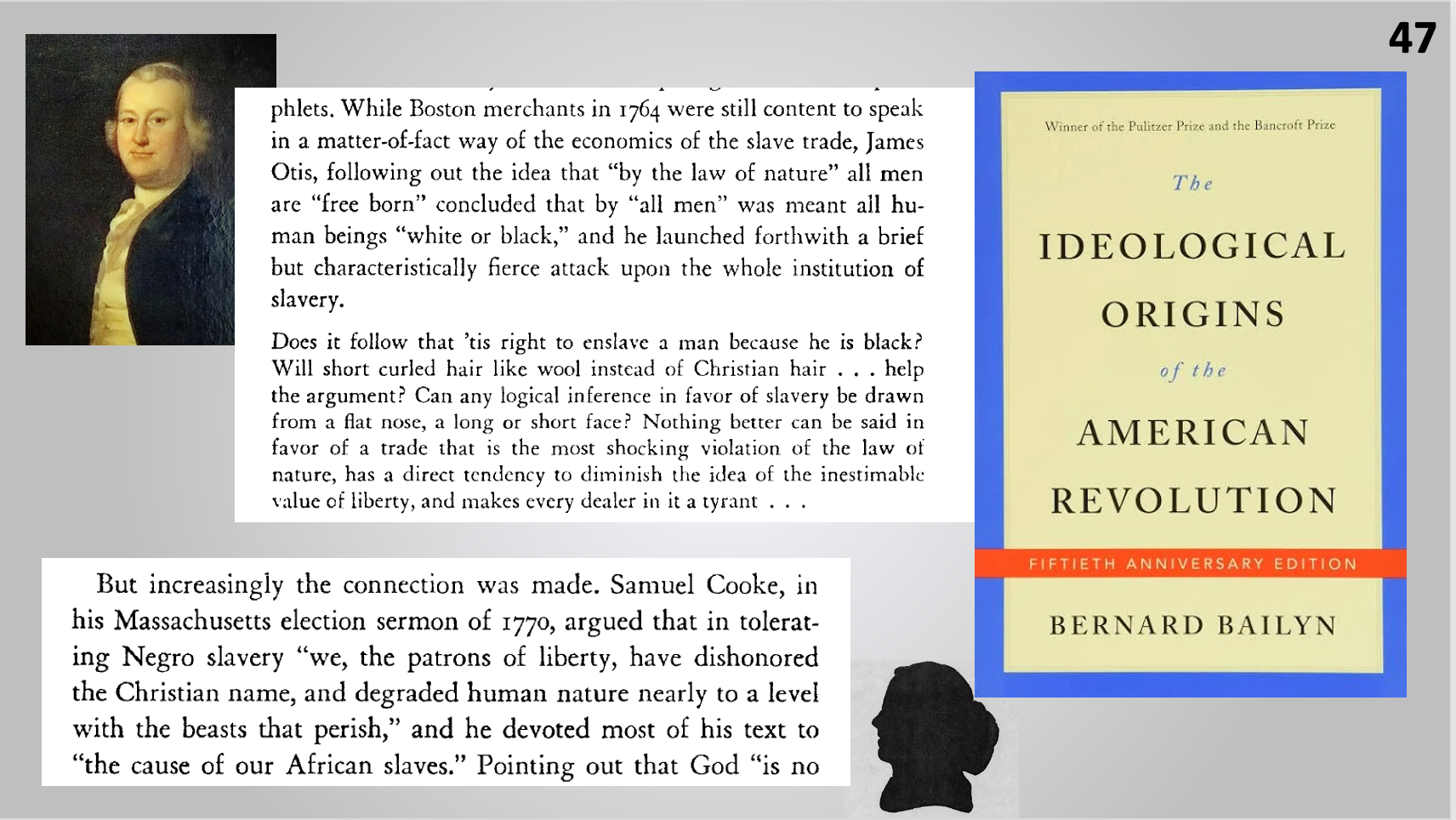
47 – And there were individuals who responded to this – in the public sphere – arguing that it was hypocrisy for the colonists to talk about themselves potentially being enslaved, when so much of the wealth of the Americas was built on the most brutal form of slavery that ever existed. It was a line of argument that was not a part of the original tax revolt in 1764, but it became an increasingly common theme of the pamphlets and newspaper reports that circulated in the colonies in the later 1760s and 1770s.
48 – It’s worth remembering that in October 1774, the Continental Congress voted to stop American involvement in the slave trade. And while the realization of this goal was delayed until the nineteenth century, it still – perhaps – shows the power of a free and open debate – and an aspiration to a political system where the people rule themselves – in helping individuals to recognize injustice – and to attempt to take action against it.

49 – The flawed origins of a free press and a representative system of government that holds out the promise that all are created equal – should not prevent us from owning that legacy as our own – and working as hard as we can to expand the range of individuals to whom those promises are thought to apply – and doing the hard political work to make those promises real – The American flag is also already a PRIDE flag – because we were already included in its promises – just as women and people of color were – Yes, we have to fight in the public sphere to get others to see that – but that’s our duty as citizens
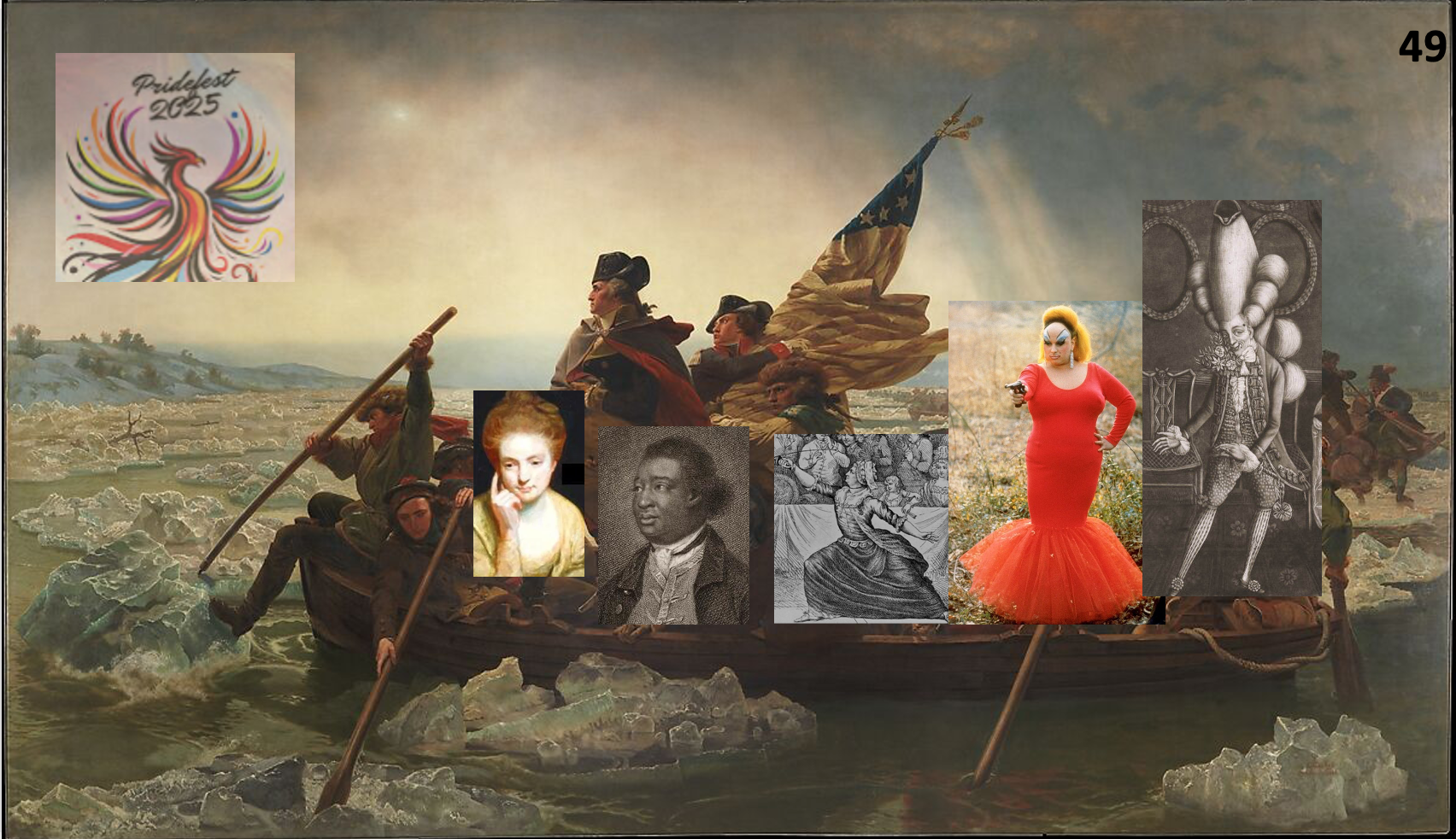
50 If we just accept what we’re told our government is and should be – then we may as well just be the subjects of a king – It’s our job to use our reason and virtue – to make our world into that more prefect union – that’s the American Revolution that we share – that we embrace – that we celebrate – and that we remake and renew in the struggles of every generation. – Thank you

 Projects in History