
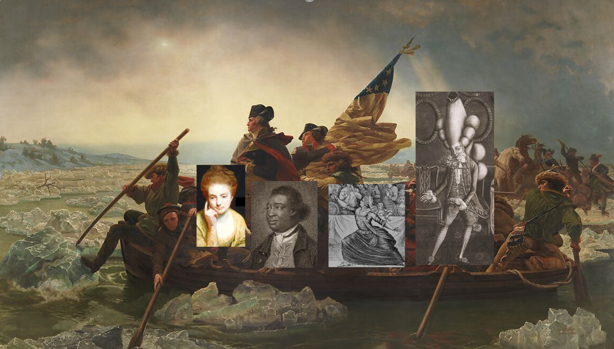
In September, 2026, the Journal of British Studies publshed my article “‘Called It Macaroni’: A British Queer History of the American Revolution,” in their FORUM: 1776. Views from the British World series. Timed to coincide with the two hundred and fiftieth anniversary of the Declaration of Independence that launched a revolution that created the United States of America, this series of articles complicates traditional narratives of this transformative event by situating it in a larger British world context. My article in this series outlines the methodologies informing and content of my current book project, “Called it Macaroni”: A British Queer History of the American Revolution, as I presented them in public-facing lectures for Tallahassee Pridefest in 2025 and 2026. This project examines a range of individuals, from the lowest to the highest social ranks on both sides of the American Revolution, who expressed feelings of same-sex desire or trans gender. Also, more importantly, it explores the ideologies that underpinned the American Revolution, and highlights the ways in which they contain the basis for queer and trans inclusion, as well as supporting critiques of injustice around race, class, gender, and citizenship more broadly. I argue for the value of starting the story of the American Revolution in Britain in the seventeenth century and ask whether doing so, and placing aspirational ideals at the heart of the narrative, can provide a framework for a simultaneously optimistic, historically accurate, and broadly inclusive narrative that does not misrepresent any group’s struggle for the sake of forging a consensus.
A version of this argument was published in Ms. Magazine, as a part of its “Founding Feminists” series in March 2026, in an article titled “Claiming the Revolution: Gender, Sexuality, and the Radical Promise of 1776.” The detailed (c. 14,000 words) academic framework supporting the argument was published in the Journal of British Studies, in their “Debating the Field” series, in an article titled “Rethinking Periodization, Priorities, and Liberalism in British Queer History.”
These ideas were first presented to the public in talks were delivered as a part of Tallahassee Pridefest, in the Florida Capital, “‘Called it Macaroni’: Citizenship, LGBTQ History, and the American Revolution” in March 2025, and “Claiming the Revolution: Feminists, LGBTQ People, and 1776” in March 2026, and both were well received. The book that is coming out of this project will be my third, and is an outgrowth of my broader research as a Professor of British History at Florida State University.
Does your town, city, or organization need a LGBTQ history talk celebrating the 250th Anniversary of the American Revolution, emphasizing what unites us all as Americans? I’m making these lectures freely available to anyone who wants to use them (I’ll send you the PowerPoints, or invite me, and I can deliver one in person).
For an example of my public lectures on my rearch, there is a recording of the 35-minute presentation I did for the iMagine! Belfast Festival in 2022 on my previous book, which explored the ways in which liberal poltical arguments and liberal poltical practices played a central role in the parliamentary effort to end the death penalty for sodomy in early nineteenth century Britiain. The talk provides an illustrated summary of the argument.
Other examples of my public outreach work include commentary in The Express on queer history in relation to Bridgerton and Queen Charlotte (and Bridgerton again). I was also interviewed about Outlander’s Lord John Grey, with stories appearing in The Daily Express, The Scottish Daily Express, The Irish Star, Glasgow Live, and The Daily Record.
I’ve written about Downton Abbey in a way that I think of as “fan non-fiction.” The academic version of the argument was published as: Charles Upchurch, “Undoing Difference: Academic History and the Downton Abbey Audience,” Journal of British Cinema and Television 16 1(January 2019): 28-41. A popular version was published in the Huffington Post.

